

Why Your Restaurant Absolutely Needs a Mobile App
There’s a lot of preachy advice out there on how important it is to develop a mobile app and make sure you have a strong mobile presence.
But the vast majority of that advice is written by app development companies with no real concern over how well your business eventually does as a result of your marketing efforts… they just want to scare you into signing up for their services by throwing out scary-sounding numbers that may or may not be backed up by actual, published facts.
But when you consider that 60% of local searches on mobile convert into buying customers within the hour, and the fact that Starbucks (a company notorious for leading the trends in the food and beverage industry) conducted 16% of their monetary transactions over their app alone.
Key Takeaways
- Mobile Conversion: 60% of local searches on mobile convert into buying customers within the hour.
- Starbucks Success: Starbucks conducted 16% of their transactions via their app, showcasing the potential of mobile apps.
- Revenue Impact: $1.6 billion of Starbucks’ $10 billion revenue was generated through mobile transactions.
- Trend Adoption: Mobile presence is a growing trend in the restaurant industry, crucial for staying competitive.
- Investment Worth: Evaluating the potential revenue and customer engagement can help decide on investing in a mobile app.
Which means that even though someone has to be in a physical Starbucks location to buy one of their drinks, $1.6 billion of a $10 billion revenue was all done via mobile.
I don’t know about you, but I don’t think $1.6 billion is anything to cough at.
So it’s clear that the ideal of mobile for restaurants is an upcoming trend… but the real question is, is it worth the investment for your business?
We’ve got 14 data points to present to you… all complete with real-life examples to help you do the math on the potential revenue and customers you’re missing out on so you can make that decision to invest in a mobile app for your restaurant.
1. Location-Based Deals
I think by now we’re all familiar with Apple’s iBeacon.
For those who aren’t, it’s basically a small device you can set up in and around your location to send push notifications and deals to people in your location’s physical proximity to lure them into your restaurant during meal time.
Beyond that, you can also rely on a person’s GPS settings to tell you where they are and send out relevant deal information if you’ve got more than one location.
The Bookatable app, for example, started using beacon-based technology in 119 of their participating London restaurants, sending push notifications to users of the app who walked within a 50-meter radius of one of the restaurants.
By doing so, they were able to jump out at users of the app who might be looking for a bite to eat, but weren’t sure exactly where to go. By helping totally eliminate or expedite that decision-making process, Bookatable was able to get more visitors into their participating restaurants, boosting their business.
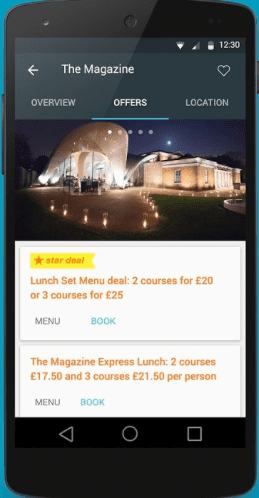
Bookatable offers location-based deals using beacon technology.
But beyond sending push notifications about deals to prompt more purchases, you can make sure people know where they’re going, find the right place, and don’t get sidetracked into another restaurant while they’re walking that last stretch to your restaurant’s front door.
2. Loyalty & Referral Programs
On Black Friday 2015, a pizza joint called Pizza Ranch ran a promotion that gave their customers double points for coming in and buying from them that day, which generated 67.6% more business for that day than they normally do.
It was such a successful and low-cost strategy to employ that their ROI was 780% on the money and time they invested.
One of the biggest reasons this works is the fact that mobile-based loyalty programs are far more personal than the ones that involve a simple punch-card being handed out to every customer who buys a drink.
The data and the interaction is on their phone, a device that hardly ever leaves their side.
Plus, you can insure continued use of your loyalty program and more purchases to contribute towards final goals by sending push notifications reminding your loyal customers how close they are or suggesting for them to come in for a meal or a drink that would put them over the edge points-wise for their prize.
But don’t just think that loyalty programs are solely about the free stuff.
According to research, 65% of restaurant customers would be willing to download your restaurant’s app if you promised them exclusive offers and deals from time to time, and a whopping 80% of those people would proactively return to your restaurant to reap the benefits… even if it meant they’d have to keep buying a few times before they got anything.
Broken down, that’s 52% of ALL restaurant-goers (which in the US, is just about everyone—so you’ve got over half of the population) willing to download your app and proactively return to your restaurant to redeem deals and loyalty promotions.
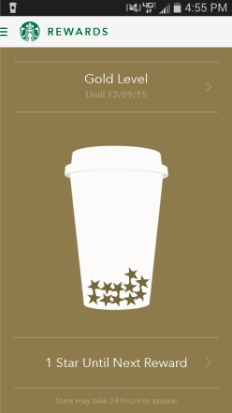
Effective rewards programs don’t have to be elaborate or difficult… as you can see with this screenshot from Starbucks.
Ka-ching.
Beyond that, you can incentivize your customers to refer their friends and fam
Frequently Asked Questions
How can a mobile app increase restaurant sales?
A mobile app can increase restaurant sales by offering location-based deals and loyalty programs that encourage repeat visits. Platforms like Buildfire make it easy to integrate these features into your app.
What are the benefits of using push notifications for restaurants?
Push notifications can remind customers of special deals or prompt them to visit your restaurant. Buildfire, for instance, offers tools to easily set up and manage push notifications.
How do loyalty programs in mobile apps work?
Loyalty programs in mobile apps track customer purchases and reward them with points or discounts. Tools like Buildfire allow businesses to customize these programs to fit their needs.
What is the role of GPS in restaurant mobile apps?
GPS in restaurant mobile apps helps in sending location-based offers and guiding customers to the nearest restaurant location.
How can a restaurant app improve customer engagement?
A restaurant app can improve customer engagement by providing exclusive offers, easy reservations, and personalized experiences, enhancing overall customer satisfaction.
Where possible, try to add photos of your product (food) in context (people eating it). Showing the food “in use” adds action, interest, and helps app users imagine themselves happy and in the exact same situation.
Geez, is anyone else hungry now?
Conclusion
I’ve got a secret for you.
Even though it feels like app marketing and app development is being preached to small businesses and restaurants like crazy, 95% of restaurants didn’t have an app a year ago.
So this means if you do decide to develop one, you’ve got the potential to be one of the top 5% of restaurants in your area. Which is a pretty big deal, if you think about it.
The reason, we think, is because while the idea to develop an app is a good idea, the work behind making it a reality is too much for busy restaurant owners to handle.
Which is why we’ve set up a system where you can set up a basic app for your restaurant that will get you a lot of the benefits we’ve discussed above. The creation is free, won’t take even the slowest person more than half an hour, and you don’t start paying for it until you’re ready to use it.
Go ahead, check it out.
FAQ
- What are the benefits of having an app for my restaurant?
Having an app can increase customer engagement, streamline ordering processes, and enhance customer loyalty. - How long does it take to develop a basic restaurant app?
With our system, it can take less than half an hour to set up a basic app. - Is it expensive to maintain a restaurant app?
You only start paying for the app once you’re ready to use it, making it cost-effective. - Can I customize the app for my restaurant?
Yes, our system allows for customization to fit your restaurant’s needs. - Do I need technical skills to create an app?
No, our system is designed to be user-friendly, even for those with no technical background.