Key Takeaways
- Mobile Traffic Dominance: Over 52% of global internet traffic now comes from mobile devices.
- In-App Advertising Growth: In-app advertising expenditure reached $201 billion in the US last year.
- Projected Ad Spend: Combined mobile ad spend is expected to hit $340 billion in two years.
- Ad Network Choices: Numerous mobile ad networks make it challenging to choose the best one.
- Dual Approach Options: Businesses can buy ads or sell ad space, or do both.
Types of Mobile Ads
So you’ve decided that you want to run some ads. That’s great. But not all mobile ads are the same. These are the major mobile advertising formats that you can buy or sell through ad networks.Banner advertisements
Banner ads on mobile devices are similar to banners you’ve seen when you’re browsing the Internet. The only difference is that these banners are displayed within the interface of an app. Banners typically promote products, services, or even upsells for in-app purchases.Native advertisements
Native ads match the interface of an app. The whole idea behind this format is for the advertisement to feel natural and less intrusive, as opposed to something like a pop-up.Interstitial advertisements
Interstitial ads cover the entire screen. They appear when users navigate from one screen to another. Here’s an example of what this would look like.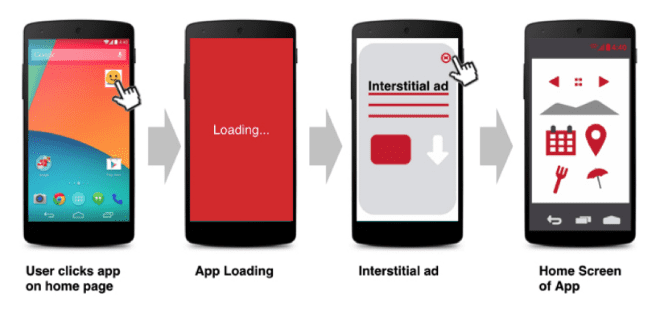 The most important thing to remember with this ad format is that you only display the advertisement after a user has completed an action or task. You don’t want to interrupt them while they’re in the middle of something.
For example, a gaming app could have an interstitial ad appear in between levels, as opposed to during actual gameplay.
The most important thing to remember with this ad format is that you only display the advertisement after a user has completed an action or task. You don’t want to interrupt them while they’re in the middle of something.
For example, a gaming app could have an interstitial ad appear in between levels, as opposed to during actual gameplay.
Video advertisements
This is pretty self-explanatory. Video ads are usually fairly short, and typically not longer than 60 seconds. There are two main types of video as.- In-stream videos — streamed in an app and played within video content.
- Out-stream videos — played on a web page that gets displayed within an app.
OfferWall advertisements
As the name implies, OfferWall advertising provides offers. These offers are meant to drive engagement. For example, a mobile gaming app could have OfferWall ads that promotes other games from the same developer.Mobile Ad Revenue Models
In addition to the types of ads available, there are different business models for buying and selling mobile ads. I’ll explain the top five models.Cost-per-click (CPC)
With CPC ads, the advertiser gets charged each time someone clicks on their ad. This model is better for advertisers because they only get charged when a consumer is interested enough to make a click. From a seller’s perspective, CPC can be a bit risky. Publishers are potentially giving away impressions for free with this model.Cost-per-install (CPI)
Advertisers are only charged when clicks turn into an app install with the CPI model. This is one of the most important metrics for marketers to track. App installs can translate to customer acquisition costs, and ultimately determine the ROI for these ads.Cost-per-action (CPA)
CPA is similar to CPI, but it’s a bit more advanced. Advertisers are charged for certain actions, such as signing up for something, submitting a form, subscribing, or making an in-app purchase.Cost-per-mile (CPM)
CPM is based on how many times the ad is shown. This model is best for publishers because they get paid even if the user doesn’t click or perform an action. Typically, the charge is per 1,000 times an ad is shown. While this a safe revenue for someone selling ads if they have lots of traffic, it limits their opportunity to make more money. If that ad sparks lots of interest and leads to clicks and installs, the publisher won’t be rewarded for those additional actions.Cost-per-view (CPV)
CPV is for video ad campaigns. The cost is based on how many times a video ad is viewed. This advertising model is becoming increasingly popular. As we previously mentioned, the US is expecting to see a 64% increase ($16 billion to $25 billion) in mobile video ad spending over the next three years.Mobile Ads Targeting
There are several different ways for advertisers and publishers to display mobile ad campaigns designed to reach a specific audience. Failure to reach the right audience will obviously impact the results of your ad. These are some of the most popular ways to segment mobile ads.- Gender — Narrow down mobile users based on their sex.
- Device — Target users with specific hardware requirements and screen sizes (such as smartphones vs. tablets).
- Geographic — Reach mobile users in a specific region that’s relevant to the ad.
- Operating System — Run ads on devices with a specific OS.
- Carrier — Target mobile users on a specific carrier plan (Verizon, ATT, Sprint, etc.).
- Connection Type — Target devices based on connections such as 3G, 4G, LTE, or WiFi.
- Interests — Advertising networks collect data about m
Mobile Advertising Rankings
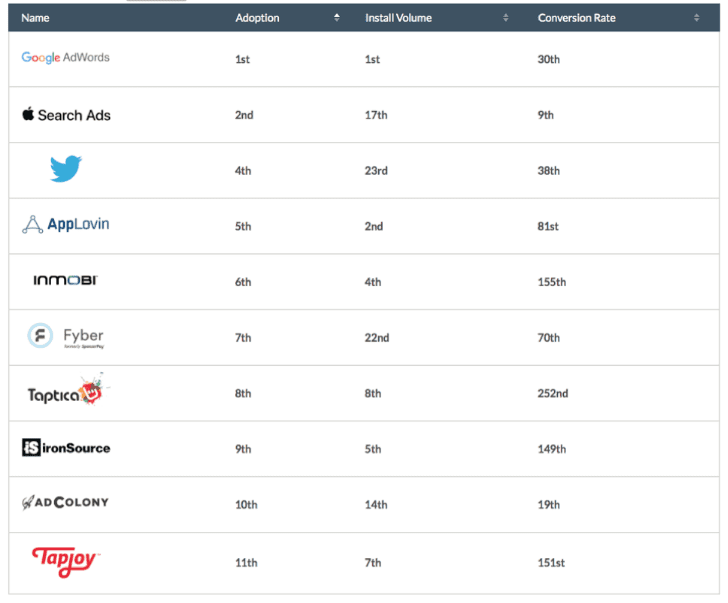
So, which advertising networks are the best? It’s difficult to say definitively since there is so much data out there to take into consideration. Here’s a look at North America’s top ad networks for reaching app customers, according to TUNE. TUNE analyzed more than 1,000 networks and publishers. The data from their customers concluded that the ad networks shown on this table were the most widely used in terms of customer reach.
As you can see, popularity doesn’t necessarily translate to results. Only one of the top three networks by adaption ranked within the top ten for conversion rates. But that information needs to be taken with a grain of salt. As we’ve already discussed from the different revenue models, conversions aren’t always applicable. You could run CPM and CPV ads successfully without any conversions. What works well for one company may not necessarily work for another. It all depends on the type of ad you’re running and the goal of your mobile ad campaign. The same concept can be applied to publishers as well. You might make more money with one format over another.Network Popularity Conversion Rate Network A Top 3 by Adaption Not in Top 10 Network B Top 3 by Adaption Not in Top 10 Network C Top 3 by Adaption In Top 10 Platform Comparison
Platform Supported Platforms Campaign Types Unique Features YouAppi Android, iOS CPI, CPA Re-engagement ads Snapchat Ads iOS CPI, CPC Filters and lenses Twitter Ads Android, iOS CPI, CPM, CPC Deep linking technology Applovin Android, iOS, Mobile Web CPC, CPA Custom targeting and ad formats Taptica Global CPA, CPC High ROI, custom targeting AppLike iOS, Android CPC A/B testing, app usage targeting GOWIDE Asia, Europe, North America CPI, CPC, CPA, CPE 500,000 in-app events monthly Smaato iOS, Android, Windows Phone, Mobile Internet CPC Specializes in banner ads Mobvista Android, iOS CPI, CPA, CPS, CPL AI technology, unique ad formats Headway Global CPI Focus on mobile ad platform Mobidea
 Mobidea specializes in CPA campaigns. They also support a wider range of mobile platforms compared to most networks that you’ll come across.
Advertisers can efficiently calculate and track the ROI of each campaign they run with Mobidea, making it a top option to consider. If you advertise through this network, you’ll get notifications with data covering topics like churn rates, unqualified leads, and most effective traffic sources. This mobile advertising company supports banners, overlay ads, pop-ups, redirects, and banner advertisements. All of the targeting options are customized and reach global markets.Platform Android iOS Feature phone Windows phone Mobile web Platform Campaign Models Ad Formats Target Regions myAppFree CPI, CPA, CPC Banner ads, Interstitial ads, Native ads, Notifications Asia, Europe, United States, Latin America Billy Mobile CPC, CPI, CPA, CPL Banners, Videos, Direct link ads Global markets IronSource vs. Webpals Mobile
Feature IronSource Webpals Mobile Platforms Supported Android, iOS, Windows Phone, Amazon, Adobe Air, Cocos iOS, Android Ad Formats Interstitial, Video, Offerwall Banner Ads, Video Ads, Native Ads Business Models Not specified CPA, CPI, CPL, CPE Market Reach US, Israel Global 

Startapp vs. Persona.ly
Feature Startapp Persona.ly Targeting Options Connection type, gender, OS, mobile carrier, device, geographic location, competitors Custom targeting for Android and iOS platforms Ad Formats App icon ads, in-app ads, interstitial ads, video ads, full page ads Interstitial, OfferWalls, Rich Media, Video, Banners Campaign Types CPA, CPC, CPM, CPI Not specified Platforms iOS and Android Android and iOS  Startapp lets you target users based on things like connection type, gender, operation system, mobile carrier, device, and geographic location. They even have an option for targeting users based on your competitors, which is unique compared to the majority of mobile ad networks on our list.
The ads run with Startapp are interactive and engaging. They use real-time data to enhance their targeting methods.
Startapp offers app icon ads, in-app ads, interstitial ads, video ads, and full page ads as well.
You can run CPA, CPC, CPM, and CPI campaigns targeting global markets on iOS and Android platforms with Startapp.
Startapp lets you target users based on things like connection type, gender, operation system, mobile carrier, device, and geographic location. They even have an option for targeting users based on your competitors, which is unique compared to the majority of mobile ad networks on our list.
The ads run with Startapp are interactive and engaging. They use real-time data to enhance their targeting methods.
Startapp offers app icon ads, in-app ads, interstitial ads, video ads, and full page ads as well.
You can run CPA, CPC, CPM, and CPI campaigns targeting global markets on iOS and Android platforms with Startapp.
Persona.ly
 Personal.ly has an SDK that offers interactive advertisements for developers. The ad network supports multiple formats:
- Interstitial
- OfferWalls
- Rich Media
- Video
- Banners
- Video ad
- Native
- Banner
- OfferWall
- Interstitial
- Trigger
Mobrain
 Mobrain specializes in CPI campaigns.
Their network includes fraud protection technology, which is an added benefit for advertisers who have a fear of being taken advantage of by publishers.
The great part about Mobrain is that advertisements can automatically change and be adapted to various formats such as:
Mobrain specializes in CPI campaigns.
Their network includes fraud protection technology, which is an added benefit for advertisers who have a fear of being taken advantage of by publishers.
The great part about Mobrain is that advertisements can automatically change and be adapted to various formats such as:
- Banners
- Videos
- Interstitial
- Native
Tappx
 Tappx offers a very unique business model for advertisers. Rather than paying for advertisements, you can get them for free in exchange for running ads for other apps.
Essentially, you’re just trading advertising space with other developers who are also on this ad network. It’s a great option for those of you who are looking for cost-effective ways to promote your app.
Tappx also has standard CPM pricing models if you’re not interested in the trading ad space option.
This ad network generates over 400 billion monthly requests for 35,000 mobile apps on their network.
Tappx offers a very unique business model for advertisers. Rather than paying for advertisements, you can get them for free in exchange for running ads for other apps.
Essentially, you’re just trading advertising space with other developers who are also on this ad network. It’s a great option for those of you who are looking for cost-effective ways to promote your app.
Tappx also has standard CPM pricing models if you’re not interested in the trading ad space option.
This ad network generates over 400 billion monthly requests for 35,000 mobile apps on their network.
Conclusion
When it comes to choosing a mobile ad network, clearly, you’ll have plenty of options. So what’s the best mobile ad network? It depends on what you’re looking for. There are so many factors to take into consideration. As I said earlier, what works for one brand may not be the best for another. First, you have to determine if you want to use these networks as an advertiser to promote your own app, or as a publisher to monetize your app by selling ads. Next, you’ll have to factor in things like the mobile platforms the networks support, the campaign types they run, and the ad formats they allow. Some ad networks have a greater reach in certain markets compared to others.
So take all of this into consideration and use this extensive guide as a reference to help you find the best mobile ad networks for your app. What are the most important features you look for in a mobile advertising network?Feature DU Ad Platform Mobrain Ad Formats Video, Native, Banner, OfferWall, Interstitial, Trigger Banners, Videos, Interstitial, Native Targeting Options Custom targeting for global markets OS version, carrier, location Frequently Asked Questions
What is a mobile ad network?
A mobile ad network connects advertisers with apps where their ads can run. As over 52% of all internet traffic worldwide now comes from mobile devices, these networks are central to reaching people where they actually are.
What types of mobile ads are there?
The main formats are banner ads, native ads, interstitial ads, and video ads — each fitting a different balance of visibility and user experience within an app.
Why is mobile advertising growing?
Because the world keeps trending mobile — over half of all internet traffic is now mobile, more than double the share of five years ago. As that grows, mobile advertising follows the audience.
What’s the difference between native and interstitial ads?
Native ads blend into an app’s content so they feel less intrusive, while interstitial ads are full-screen and appear at natural breaks. Each trades visibility against how disruptive it feels to users.