

Mobile app development has lots of moving parts. Each team member has unique responsibilities, but all work towards a common goal.
It’s easy for this process to get derailed if you don’t have the right plan—and proper planning all starts with project management.
But there are several different project management methodologies and frameworks to choose from. Some work well for mobile apps and software product development, while others aren’t so useful.
If you’re building an app and you’re not sure what project management method is the best, then you’ve come to the right place. I put this guide together based on years of first-hand experience managing project teams—specifically in the mobile app and software space.
Best Project Management Methodologies For Software and Apps
A quick Google search will yield dozens of project management methods. Exactly how many project management methodologies are there? It depends on who you ask.
You’ll see terms like agile, scrum, waterfall, kanban, lean—the list goes on and on. There are even hybrid management methods, like scrumban, agilefall, and more. Between the different methodologies and specific frameworks within those methods, it’s easy to get confused.
Rather than wasting time explaining every project management methodology under the sun, we’re going to focus specifically on the methods for app development.
The following sections will teach you more about each method, how it’s used, and why it works so well for software teams.
Agile Project Management
The agile project management methodology prioritizes maximum value against the business goals within an allowable time and budget. This method empowers team members and supports the constant delivery of value to the project.
As an iterative approach to completing a project, agile management promotes velocity and adaptability.
In short, the agile methodology is flexible. Rather than following a linear path from start to finish, different incremental steps and iterations are delivered in shorter bursts. This allows for maximum flexibility, as things can change throughout the project life cycle.
Agile project management is comprised of multiple stages—requirements, design, development, testing, deployment, and review.
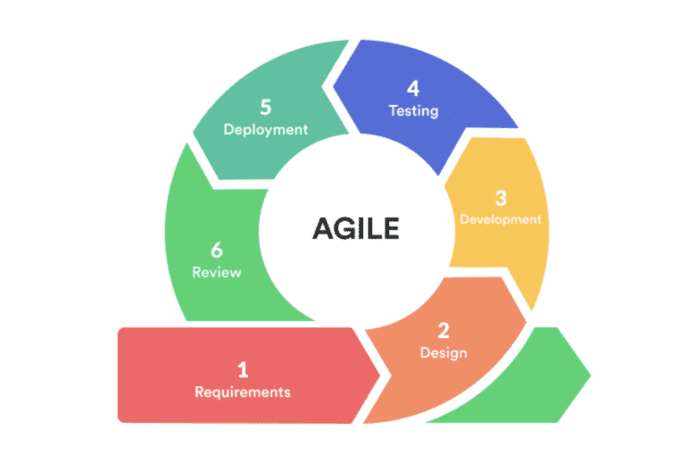
These stages help reduce and mitigate potential risks, which is crucial for app development.
Instead of looking at an app from start to finish, the project is broken down into shorter cycles, usually about two or three weeks each. Your project team will follow these stages for each cycle, which has constant testing and review throughout.
Agile works well for client and stakeholder collaboration, as the results of each iteration will be reported back to the stakeholders. This allows them to have more control over the development process.
For example, let’s say you’re building an enterprise app with an in-house software team. Rather than just telling them what you want and waiting for the finished project, agile project management empowers you to be involved throughout the process.
Some of the top advantages of agile project management for app development include:
- Ability to fix bugs after each stage
- Easy to make quick changes throughout the development project
- Constant collaboration with clients and stakeholders
- Breaks the project up into multiple stages
- Prioritizes budgets and timelines
The biggest drawback of agile PM is working with a difficult stakeholder. If they’re unable to review things after each sprint, it can push back your initial timeline and drag things out longer than they need to be.
Agile project management requires a bit more planning from the start as well. The project manager needs to identify the top priorities of the software that should be handled first.
Scrum Project Management
Scrum is a project management methodology that follows the same core values and principles as agile. So you’ll want to keep those agile concepts in mind if you’re using this method.
All work gets completed in short cycles, called sprints. Scrum teams meet on a daily basis to quickly discuss the current tasks they’re working on and any obstacles they’re facing.
Daily scrums are also known as stand-up meetings. The idea here is that the meeting is so short that nobody has to sit down. Even if your software team is working remotely, it’s important that you stick to the daily scrum.
Another crucial component of scrum is the product backlog. This is essentially a list of prioritized tasks that must be completed. These product goals are broken down into sprint backlogs, and ultimately turned into increments when they can be marked as “done.”
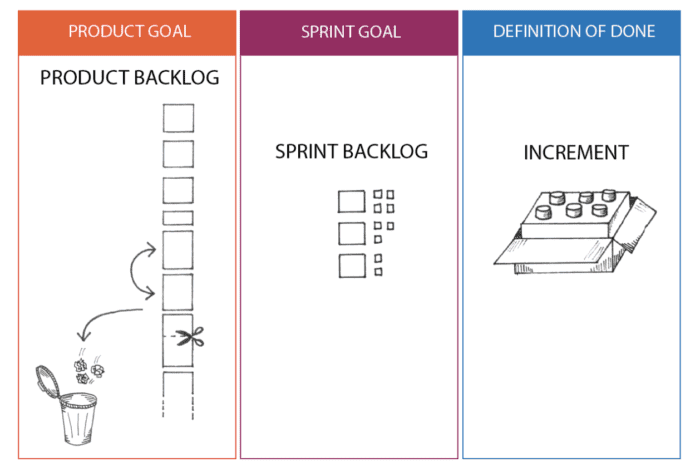
Kanban boards are useful for managing these backlogs. It allows everyone on your team to clearly see what’s being worked on, what’s been completed, and what needs to get done—all in real-time.
In addition to the daily scrum, there are several other meetings that help make scrum project management so effective for software teams.
- Sprint Planning — The tasks of highest priority are defined before each sprint. Product owners or stakeholders explain the backlog to the software team, removing all ambiguities. The team communicates how much work they can get done within the allowed timeframe. Sprint goals and sprint backlogs are created by the end of the meeting.
- Daily Scrum — Held every day, usually for 15 minutes max. Each team member will quickly explain what they accomplished yesterday, what they’re working on today, and define any roadblocks or bottlenecks they’re faced with.
- Sprint Review — This meeting is held after each sprint to determine what’s been achieved in the past few weeks. The product performance is also measured against the goals that were initially defined during the sprint planning stage.
- Spring Retrospective — What went right and what went wrong during the sprint? This meeting allows teams to reflect on what they’ve accomplished and prepare for future sprints.
Overall, this methodology works great for mobile app development due to its flexibility. The constant meetings and communication keep everyone on the same page.
By breaking the work down into tasks for completion during sprints, it allows your team to work quickly and complete the app in stages.
Other advantages of scrum project management for software development include:
- Ambiguities are removed during meetings
- All tasks and completion of tasks are clearly organized
- Responsibilities are clearly divided
- Any roadblocks or obstacles are identified immediately
- Quick releases keep teams motivated and satisfy stakeholders
Scrum project management doesn’t work well if the team isn’t committed. It’s easy for things to get off track, especially if the backlogs pile up and teams are expected to complete work in an unrealistic amount of time.
This methodology works best with small teams. Some members might be annoyed by the daily meetings, but it’s important to hold them regularly and ensure everyone stays on task. The scrum master needs to be a problem-solver to complete successful projects.
Extreme Programming (XP) Project Management
As the name implies, extreme programming is another ideal solution for app development. It’s agile framework designed specifically for producing high-quality software.
Of all of the agile frameworks, XP has the most specific use case with principles for software development. The stages of XP typically include:
- Planning
- Managing
- Designing
- Coding
- Testing
Here’s a visual overview of the extreme programming lifecycle:
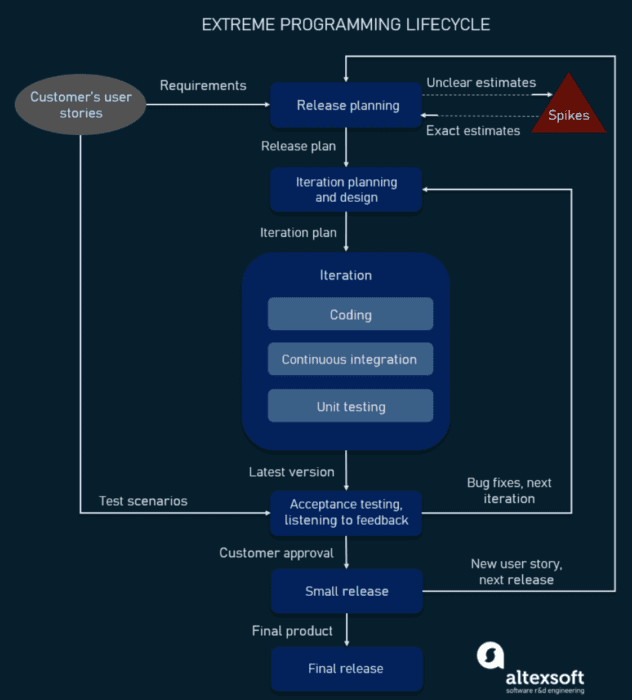
There are five core values of extreme programming, which each contribute to the framework’s success for app development:
- Communication — Team members must transfer knowledge to each other. Visual tools like whiteboards or other drawing mechanisms can be extremely helpful as teams explain ideas and concepts to each other.
- Simplicity — Avoid waste at all costs. Keeping the system and design as clean as possible makes it much easier to maintain the software, provide support, and fix bugs down the road. Focus only on what you know right now, without trying to predict the future.
- Feedback — Teams must get constant and immediate feedback about their effort. This helps everyone identify areas where they can improve, and continue doing what works well. Feedback loops also allow you to adjust the final product product going forward.
- Courage — Software teams must have the courage to accept feedback, even if it’s difficult to swallow. They also need the courage to stop doing something that isn’t working, and move forward trying something else. If there’s an issue or problem, team members must have the courage to speak up. All of this helps improve the team’s efficiency, even if these decisions can be uncomfortable.
- Respect — Respect ties all of these values together. It’s impossible for software teams to provide feedback and speak up in certain scenarios without respecting each other. XP relies so heavily on constant communication that respect needs to be a priority.
Again, XP is specific to software development. It can be challenging to implement with inexperienced developers. The methodology doesn’t always work if teams are working together for the first time, as they may not be comfortable communicating with full transparency.
Waterfall Project Management
The waterfall methodology is the simplest way to plan any project. It’s not necessarily the most common methodology for app development, but it can work well for basic apps.
It’s also worth noting that the waterfall project management methodology is arguably the easiest to implement. So if you’re a new project manager and just getting your feet wet managing teams, this could system can help you build confidence.
Following a sequential order of steps is the primary concept of the waterfall method. Tasks flow in order, and one step must be completed before the next one starts.
Just like a waterfall, everything flows down—you can’t turn around and go back upstream.
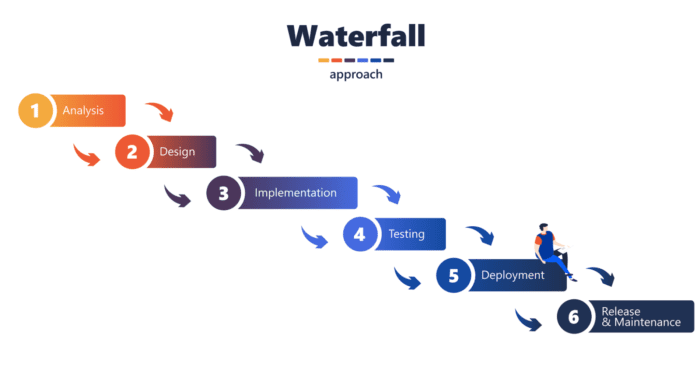
It’s easy for teams to understand the waterfall process because everything is straightforward. But it doesn’t work well with larger teams.
Waterfall project management doesn’t typically work for complex projects because the framework isn’t very adaptive. It doesn’t allow for changes throughout the development project, and many developers find it pretty limiting.
With that said, there are definitely scenarios where the waterfall project management methodology is perfect for app development.
Let’s say you’re building an app on a no-code development platform, like BuildFire. If you’re doing this on your own without a dedicated software team, the waterfall method will work fine. It’s not like you can work on two things simultaneously anyways—you’re just one person. So the waterfall method will keep you on track and give you a clear list of sequential steps to follow as you’re creating an app from scratch.
Kanban Project Management
Kanban project management is another simple concept to grasp, and the methodology can be used for a wide range of projects—including software.
This methodology gives you and your team a visual overview of the tasks associated with completing the app. Deliverables are typically categorized into three basic categories—to-do, in progress, and done.
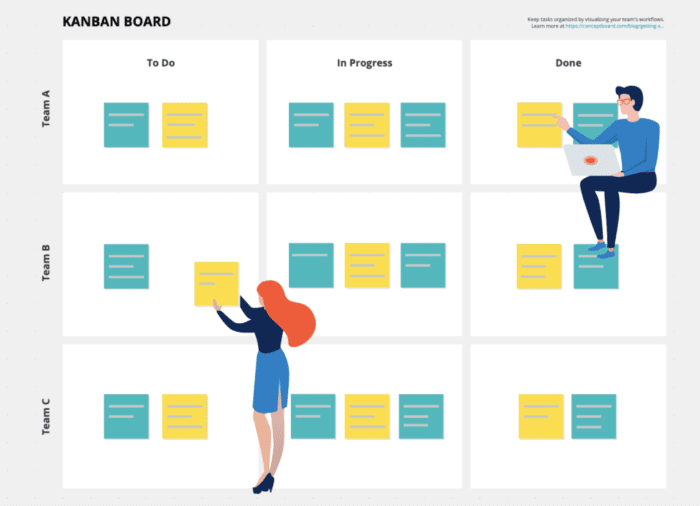
It’s common for kanban boards to be used in other types of project management methodologies. For example, we briefly touched on this earlier when discussing scrum. Lots of scrum teams use kanban boards to manage sprints.
While kanban isn’t quite as technical as some of the other project management methodologies, it’s still trusted by software teams.
Even Jira Software, one of the best project management tools for software development, has kanban project functionality.
The project manager here is responsible for assigning tasks to different team members on the board. Then each person will move the tasks to the “done” column upon completion.
Kanban also works well for managing bugs post-launch. As new bugs are reported, a new task or card can be generated in your to-do backlog. Then developers can clearly see what needs to be fixed, and move those cards from in-progress to done.
The downside of using kanban alone is that there isn’t a great way to prioritize deliverables. You can assign due dates or use a color-coding system for priority. But the methodology itself doesn’t have those types of principles built in. Kanban also doesn’t support dependencies between tasks.
Conclusion — What’s the Right Project Management Methodology For You?
So, what’s the best project management methodology for app development? It depends.
Most software teams tend to use an agile framework, as these are more flexible than some of the traditional project management and rigid PM methods. Some of you might decide to use a combination of these options. For example, scrum project management using kanban boards to track sprints is a popular option.
In addition to finding the best project management method for your app, you also need to have the right team in place to execute development. So download our free ebook on building an expert mobile app development team.
Frequently Asked Questions
What is the best project management methodology for mobile app development?
The best methodology depends on your team’s needs, but agile and scrum are popular for their flexibility and iterative approach.
How does agile project management benefit app development?
Agile allows for iterative development, which means you can adapt to changes and fix bugs throughout the project.
What are the key components of scrum methodology?
Scrum involves sprints, daily stand-up meetings, and a product backlog. These elements help teams stay organized and focused on delivering increments of the product efficiently.
How can I manage stakeholder involvement in agile projects?
Regular updates and iterations allow stakeholders to provide feedback throughout the project.
What is Scrum project management?
Scrum project management is an agile framework used to facilitate collaboration and efficiency in software development.
How does Scrum differ from traditional project management?
Scrum is more flexible and adaptive, focusing on iterative progress, while traditional methods are often more rigid and linear.