

1) Deeply research your market
The first step to inform everything you do moving forward is a thorough market research. You need to know the current offering on the market and use this knowledge to find a gap your app will fill and serve a fresh, complete solution to the problem you’re solving. Extensive market research should help you discover:- Who are your competitors?
- What is their strategy?
- What are the strengths and weaknesses of other app developers in this market?
- What are their customers saying in the reviews and on social media?
- What is their unique selling point?

Build a profitable mobile app in less time and at a lower cost than traditional solutions with BuildFire BOOK A DEMO
2) Define your elevator pitch and target audience
Can you articulate your app’s specific purpose? Can you name its difference from your website and its specific use cases? This is probably the trickiest step for business owners and marketers. Boiling all your ideas down to one or two sentences of clear purpose is hard, but it’s also one of the core steps to ensuring the success of your app. This is the time to define:- What will be the app’s key functionality?
- Can you define what problems your app solves?
- Who are the potential app users?
- Why would people want to use it?
- What is the added value compared to a mobile website?
- Which business goals will it help you achieve?
- What audience will benefit from it?
- What does that audience need and crave?
3) Choose between native, hybrid and web app
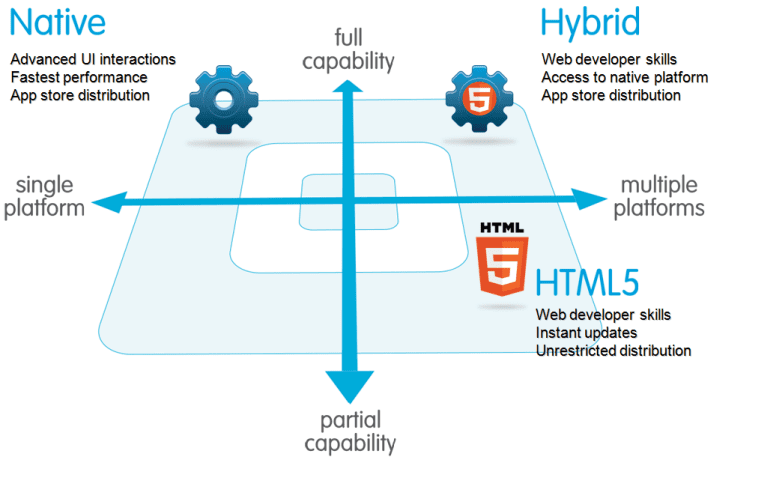
There are a couple of technical decision to make early on, and this is a crucial one. Choosing between native, hybrid, or a web app carries many implications for your later development and maintenance. This is why it’s key to leverage your market research and the core purpose and functionality you’ve just defined, so you can make the best decision. The core differentiations between native, hybrid and mobile apps are:- The programming languages they are built in. This affects and depends on your budget, desired time frames, and available expertise.
- Access to native device APIs. This will depend on the device’s functionalities that you want your app to access.
- Distribution method. This will largely affect the way you market your app and define your promotion strategies.
- Multi-platform support. This will be based on your target audience and the market you want to penetrate; most often, you will want to be present both on Apple’s App store and Android’s Play store.
4) Know your monetization options
An app can play many different roles for your business and your bottom line. Generating revenue directly off the app is an obvious one, while others may simply be serving as a resource for your audience, or indirectly assisting other phases of your sales funnel and increase your brand’s reach. What role do you want your app to play in your business model? If you are planning to make money directly from your app, this is the time to look at the app monetization models:- Freemium apps – These apps are free to download, but certain features and contents are locked, and they can only be accessed through a purchase.
- Paid (premium) apps – The user needs to purchase the app from the app store in order to use it. Because of the cost barrier of this model, a mobile marketing strategy is critical to demonstrate the unique, superior value compared to the free apps.
- In-app purchases – This model works by using the app to sell digital or physical products as a mobile commerce sales channel.
- Subscriptions – This model is similar to freemium apps, but brings a benefit of a recurring stream of revenue.
- In-app ads – This is possibly the simplest model of all because there is no cost barrier for the user. As with any advertising space, it’s important to never sacrifice user experience in order to gain more ad space.
- Sponsorships – This model usually becomes possible when you achieve a solid user base, as it allows you to partner with specific brands and advertisers. It is a win-win situation because brands pay for user actions, and your app generates further engagement for the user.
5) Build your app marketing strategy and pre-launch buzz
If there is an element that so heavily affects your app’s success, it’s the preparation to market and amplify it, including your branding, PR, pre-launch efforts, outreach, and simply overall web presence. Now, you might think it’s too early to think about app marketing before you’ve even begun your development. However, your efforts will multiply in the long run if you start creating the buzz around your app before it’s in the app stores. This is the right time to start with the following:- Define your branding. How will your name, colors, logo and the tone of your content set you apart from the millions of other apps and businesses? Ensure consistency of all these across your app and all platforms you exist on.
- Find your channels. Where does your target audience mostly hang out? Are they easier to reach through social media or email? Do they prefer video over written content? How much time are they spending on their mobile device?
- Create content. Based on your answers in the previous point, you should now know what content your audience craves and where to reach them. Start mapping out your written and/or video content and sharing it on selected channels.
- Kick off your outreach. What people are influencers in your industry, both small and large? Put some effort into reaching out to them in a personalized manner and provide them lots of value for putting your app in front of their audiences.
Build a profitable mobile app in less time and at a lower cost than traditional solutions with BuildFire BOOK A DEMO
6) Plan for app store optimization
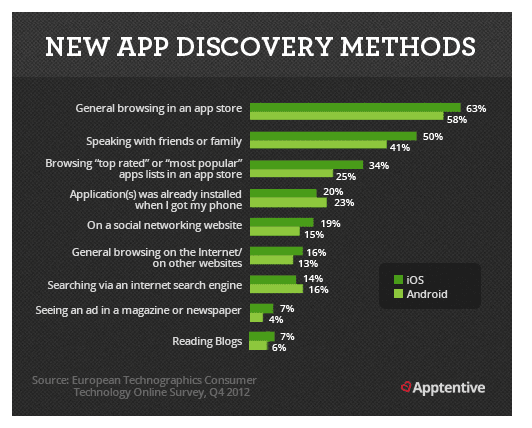
Many steps you’ve done so far, including your market research, your app’s unique purpose and your marketing strategy, largely affect your app store optimization strategy. This is the key to discoverability in the app store; over 60 percent of all apps are found through this organic search. It’s important to respect both app stores’ requirements and best practices, and use this as a brilliant opportunity for your app to shine with its visuals, features and distinctive purpose. While you won’t be able to complete all the ASO tasks this early in the process (nor should you), this is an ideal time to start sketching out your final app store look and feel, and ensure that the development follows your ideas. The key elements for app store optimization are:- App name: it should easy to spell and pronounce, unique, and descriptive, fitting within the length limits (50 characters for iOS, 30 for Android)
- Keywords: this is only applicable to Apple, and it’s an extra space to specify the search terms relevant to your app for the app meta data
- Icon: use a clear color palette, avoid using lots of small details, and opt in for contrasting colors and a simple, clear concept
- Screenshots: make sure to use all five screenshots and to leverage caption texts to tell a story and highlight benefits, including the app design
- Description: focus on the first three lines (before the ‘More…’ link) to clearly convey the key points, use bullet lists, and have a call to action
- Preview video: it should be short and go straight to the point, with a clear and universal message that will work in any localization. You can create YouTube videos and repurpose the content for ASO as well
7) Know your resources
Ideally, you’ll be able to announce your launch date ahead to create the buzz around your launch and make people excitedly wait for it. For this to happen, you need to be aware of the development time frame in front of you. According to Kinvey’s report, most businesses need between 7 months up to over a year to develop and deploy a mobile app. This is why you need to start conversations with your developers and technical teams as early as possible. This will help you guide your entire project more effectively and allocate appropriate due dates to various planning and development stages, including:- Use case(s) definition
- Mapping of required functionalities
- Minimum viable product (MVP)
- Wireframing
- Programming language/platform selection
- Coding
- App design
- App analytics
- Testing
8) Ensure security measures
And finally, you must include a privacy policy in case your app will collect any sensitive information from users. This policy needs to cover what information is being collected and how is it used. Lots of app developers are so focused on their own apps and the app idea itself that they neglect crucial security features. But security is an important step whenever you make an app or start a new app project. The benefit of taking this step so early is to give yourself plenty of time to get any legal consulting you may need, as well as plan and implement safety measures within the app. The security of your app is one of its key points, and you must ensure it is being built early in app development. Your users’ data is your most valuable asset, and you should ensure you have processes in place to collect, handle and store this data, as well as to manage any potential security risks.Final thoughts on how to start an app
How to start an app? There’s no single answer to this question. The app idea alone won’t be enough here. You need to take the right steps early to ensure success for the long run. So before you start thinking about new features and app updates, take a few hours to focus on how users interact with your app. Close your eyes and think of the user interface on a well-designed native app. How will they access an in app purchase? Think about taking your app idea and getting it ready for launch on the app store. It all starts with preparation. Once you go through these preparation steps, you will be ready to dive into your app development without distractions and lead it to a successful app deployment and launch!Frequently Asked Questions
What are the first steps to take before starting app development?
Before starting app development, it’s crucial to conduct thorough market research and define your app’s elevator pitch and target audience.
What is the importance of an elevator pitch in app development?
An elevator pitch is crucial as it succinctly conveys your app’s purpose and value. This clarity can attract investors and guide development.
What are the common mistakes to avoid in app development?
Common mistakes include inadequate market research, unclear app purpose, and choosing the wrong app type.