

Key Takeaways
- Holistic Approach: Successful customer service involves more than just prompt responses; it requires a comprehensive strategy throughout the customer cycle.
- Listening Skills: Effective listening is crucial for understanding client needs and improving conversion rates.
- Industry Trends: Staying updated with industry and technology trends is essential for delivering top-notch services.
- Customization: Tailoring pitches and services to individual client needs can significantly reduce churn rates.
- Competitive Edge: Keeping up with trends provides a competitive advantage and helps maintain strong client relationships.
Listen and Learn
It sounds simple and obvious, but you’d be surprised how many agencies lack proper listening skills. Too many agencies make the mistake of pitching a product or service without understanding the clients’ needs. You’re not a mindreader. Don’t try to become one. Give your clients and prospects the opportunity to tell you about their problems. Otherwise, it will be difficult for you to provide them with real benefits. If you’re using the same exact pitch, products, upsells, and communication for each client, you’ll have high churn rates and lower conversions. I’ve consulted with some agencies that literally copy and paste emails from one client to another, only replacing the contact’s name. While that strategy might be easier, it’s not productive. According to the Salesforce State of Sales Report, listening has the most significant impact on converting a prospect into a customer.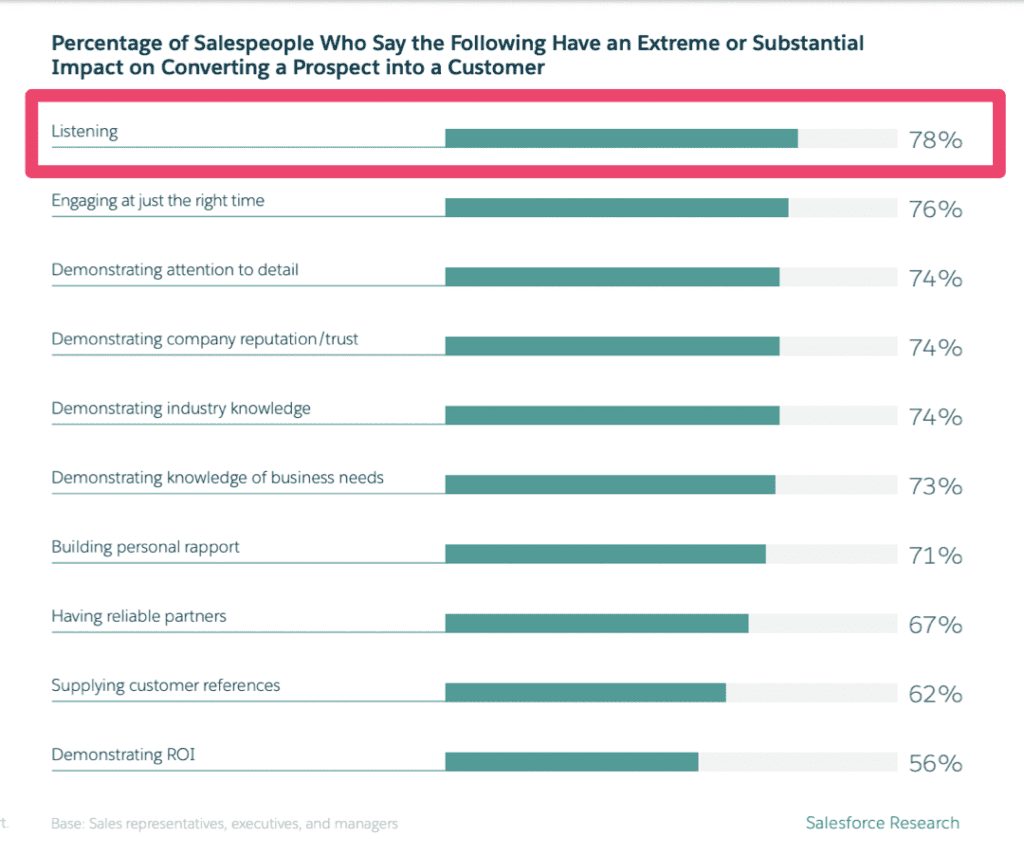 That’s not all. I recently discovered a study from Gong.io that analyzed 25,537 agency sales calls. All of the research about listening was astonishing.
The study concluded that the top closers listened 57% of the time during the average call. On the flip side, the bottom 20% of closers listened during just 34% of a call.
In short, the longer a sales representative talked, the lower their conversion rates were. But talking less and listening more yielded stronger results.
Why?
If you don’t stop and listen, you won’t learn anything about your customers. You’ll end up talking about things that are irrelevant to the prospect. This will quickly turn into them losing interest in what you’re saying.
But by giving prospects the opportunity to talk about their needs, wants, and concerns, you’ll be able to address those points directly. In doing so, your words become much more powerful.
That’s not all. I recently discovered a study from Gong.io that analyzed 25,537 agency sales calls. All of the research about listening was astonishing.
The study concluded that the top closers listened 57% of the time during the average call. On the flip side, the bottom 20% of closers listened during just 34% of a call.
In short, the longer a sales representative talked, the lower their conversion rates were. But talking less and listening more yielded stronger results.
Why?
If you don’t stop and listen, you won’t learn anything about your customers. You’ll end up talking about things that are irrelevant to the prospect. This will quickly turn into them losing interest in what you’re saying.
But by giving prospects the opportunity to talk about their needs, wants, and concerns, you’ll be able to address those points directly. In doing so, your words become much more powerful.
Listening is a crucial component of customer success tips for agencies.
Here’s a simple example.| Consultation Time Allocation | Traditional Approach | Optimized Approach |
|---|---|---|
| Introductions and Small Talk | 10 minutes | 10 minutes |
| Questions | 10 minutes | 10-15 minutes |
| Service Discussion | 40 minutes (10 minutes each for services A, B, C, D) | 45-50 minutes (Focused on relevant service B) |
Follow the Latest Industry Trends
Your agency doesn’t exist in a vacuum. There are external factors that are seemingly changing by the day, especially in the world of technology. So if you’re operating with blinders on, you’ll struggle with meeting the changing needs of your customers. This statement holds true for new prospects as well as current clients.Trends agencies need to follow.
There are lots of different trends that you need to keep up with. For starters, these are the three that you need to focus on the most.- Client industry trends
- Agency trends
- Technology trends
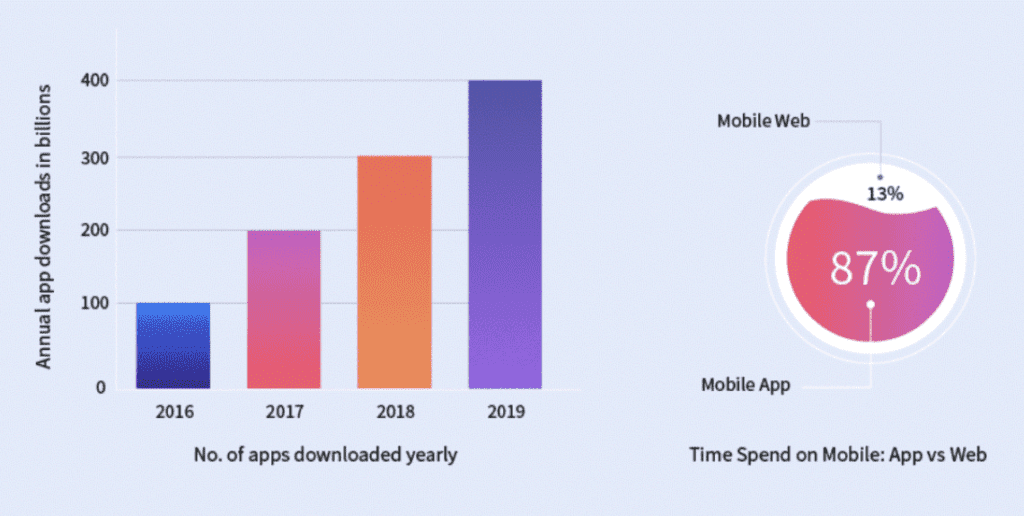 These statistics prove that building a mobile app is the greatest way to achieve this. But if you’re not following the latest trends, you might spend more time focusing on your clients’ mobile website.
Sure, that might have been a priority ten years ago. But today, app development supersedes the mobile web.
Where can you find the most recent trends? Subscribe to the Buildfire blog. We’re constantly coming up with updates for agencies and resellers. Check out some of our latest guides on mobile commerce trends and app development trends
If you don’t keep up with the latest trends, several things can go wrong.
For starters, you won’t be delivering acceptable results to your clients. This can ruin the relationship, as well as your agency’s reputation.
Other clients will be sharper than others. They follow the latest trends as well. Let’s continue with the mobile app vs. mobile web example. If your client wants to attract more mobile customers and you come back to them without mentioning app development, you’ll lose the client.
Finally, staying up to date with industry trends will give your agency an edge over the competition. You’ll learn to equip yourself with the latest tools and technology to meet the needs of your customers.
For example, once you learn that your clients need mobile apps, you must find a way to provide that service to them.
The easiest way to do that is becoming a mobile app r
These statistics prove that building a mobile app is the greatest way to achieve this. But if you’re not following the latest trends, you might spend more time focusing on your clients’ mobile website.
Sure, that might have been a priority ten years ago. But today, app development supersedes the mobile web.
Where can you find the most recent trends? Subscribe to the Buildfire blog. We’re constantly coming up with updates for agencies and resellers. Check out some of our latest guides on mobile commerce trends and app development trends
If you don’t keep up with the latest trends, several things can go wrong.
For starters, you won’t be delivering acceptable results to your clients. This can ruin the relationship, as well as your agency’s reputation.
Other clients will be sharper than others. They follow the latest trends as well. Let’s continue with the mobile app vs. mobile web example. If your client wants to attract more mobile customers and you come back to them without mentioning app development, you’ll lose the client.
Finally, staying up to date with industry trends will give your agency an edge over the competition. You’ll learn to equip yourself with the latest tools and technology to meet the needs of your customers.
For example, once you learn that your clients need mobile apps, you must find a way to provide that service to them.
The easiest way to do that is becoming a mobile app rPrioritize Communication
Similar to listening, effective communication seems like something that should be obvious. Yet so many agencies fall short in this category.| Stage | Communication Level |
|---|---|
| Early stages of a project | High |
| Towards the end of a project | Low |
| Prospects | Regular follow-up calls and emails |
| Long-term clients | Lack personal touch |
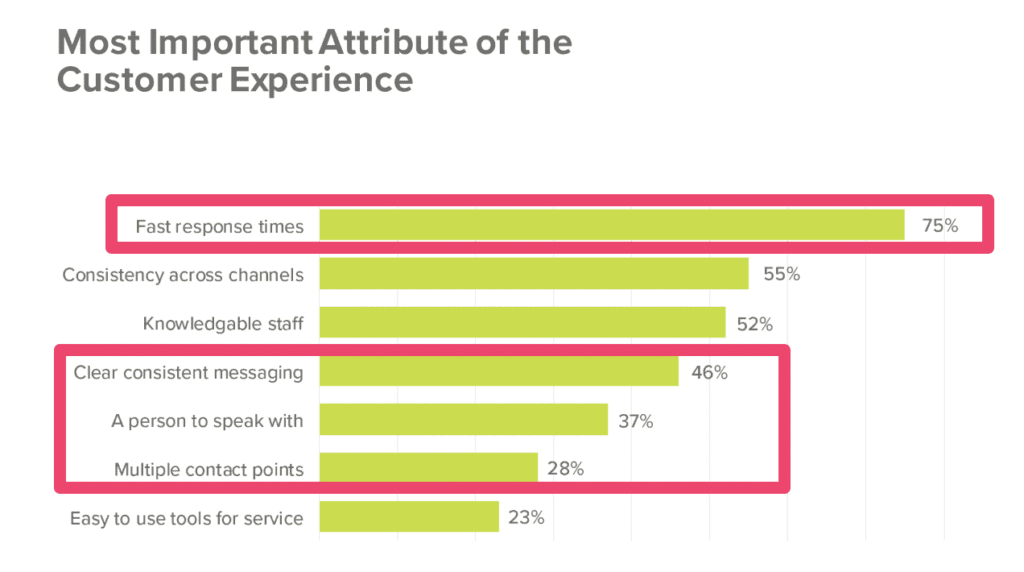 Four of the top seven responses are related to communication, including the number one answer.
Communication must be a top priority all of the time. If you’re just prioritizing this at the beginning, and right before contract renewals, it won’t be enough.
I don’t want to generalize or make assumptions, but I’m just speaking from personal experience here. To me, it seems like most agencies make the mistake of thinking that no news is good news.
If my clients were unhappy or needed something, they would let me know. I don’t need to reach out to them and check-in.
This mentality will lose clients. In fact, just 4% of unsatisfied clients actually complain.
Most people are either too nice, too busy or just don’t want to deal with any confrontation. They’ve already budgeted for the current contract. So they’ll just choose not to renew instead of complaining halfway through.
This relates back to one of our previous agency success tips about listening. That tactic isn’t just for the initial sales process. Give your clients a chance to speak their minds all of the time.
Four of the top seven responses are related to communication, including the number one answer.
Communication must be a top priority all of the time. If you’re just prioritizing this at the beginning, and right before contract renewals, it won’t be enough.
I don’t want to generalize or make assumptions, but I’m just speaking from personal experience here. To me, it seems like most agencies make the mistake of thinking that no news is good news.
If my clients were unhappy or needed something, they would let me know. I don’t need to reach out to them and check-in.
This mentality will lose clients. In fact, just 4% of unsatisfied clients actually complain.
Most people are either too nice, too busy or just don’t want to deal with any confrontation. They’ve already budgeted for the current contract. So they’ll just choose not to renew instead of complaining halfway through.
This relates back to one of our previous agency success tips about listening. That tactic isn’t just for the initial sales process. Give your clients a chance to speak their minds all of the time.
Agency communication tips.
I’m not saying you need to speak to your clients every day (although certain projects to require that level of commitment). But if it’s been a week or two since you’ve heard anything, consider sending an email similar to this one: Hey [Client Name], It’s been a couple of weeks since we last spoke. Just wanted to follow up with you to see how everything is going. We’re continuing to make significant progress on [Project XYZ]. Are you happy with the results we sent over last month? Let me know your thoughts! No rush. Looking forward to hearing back from you soon. Obviously, the content of the message will vary based on your relationship and status with each client. But I think you get the point in terms of tone and delivery. If you’re running ahead of schedule or falling behind, let your clients know. Let’s say you’re three months into a six months project. Something goes wrong, and you realize that you won’t have it completed on time. Rather than waiting until the last minute, communicate this update to your clients immediately. In most cases, they’ll understand. But they won’t be happy if six months pass without hearing a word, and the project is late.Offer New Services
Adapt or die. If your agency can’t continue to offer new services, you’ll quickly start to lose your clients. Why? Lots of agency services tend to be short term. Once the project is complete, or the problem has been solved, clients don’t have a reason to re-sign their contracts. Here’s a visual representation of how to come up with new agency services. This relates back to what we talked about earlier in terms of listening to your clients and learning about their needs.
Cumulatively, you can track the common needs of all clients. If you see a pattern, it’s a good indication that the new service will be successful.
Next, understand that your agency has limits. Not everyone has the capability to introduce every new service under the sun. That won’t automatically lead to success either.
Look at services that are easy to implement and manage. Don’t bite off more than you can chew. If the new service isn’t feasible, then it won’t be profitable either.
It’s easy to increase agency profits with a white label app reseller program. If you use the diagram above, I’m sure you’ll see that this fits every category.
This relates back to what we talked about earlier in terms of listening to your clients and learning about their needs.
Cumulatively, you can track the common needs of all clients. If you see a pattern, it’s a good indication that the new service will be successful.
Next, understand that your agency has limits. Not everyone has the capability to introduce every new service under the sun. That won’t automatically lead to success either.
Look at services that are easy to implement and manage. Don’t bite off more than you can chew. If the new service isn’t feasible, then it won’t be profitable either.
It’s easy to increase agency profits with a white label app reseller program. If you use the diagram above, I’m sure you’ll see that this fits every category.
- Your clients want new technology.
- Prospects and clients need to improve mobile penetration.
- Any agency can become a reseller.
Follow Through With Promises
Falling short with your deliverables is not a sustainable way to operate your agency. You’ll lose clients and develop a poor reputation if this becomes a habit. Things happen. Everyone makes mistakes at times. You won’t have a perfect record,and I’m not expecting you to. But there are definitely steps you can take to reduce the chances of failing to deliver. According to a recent study from Sprout Social, these are the biggest pain points for agencies.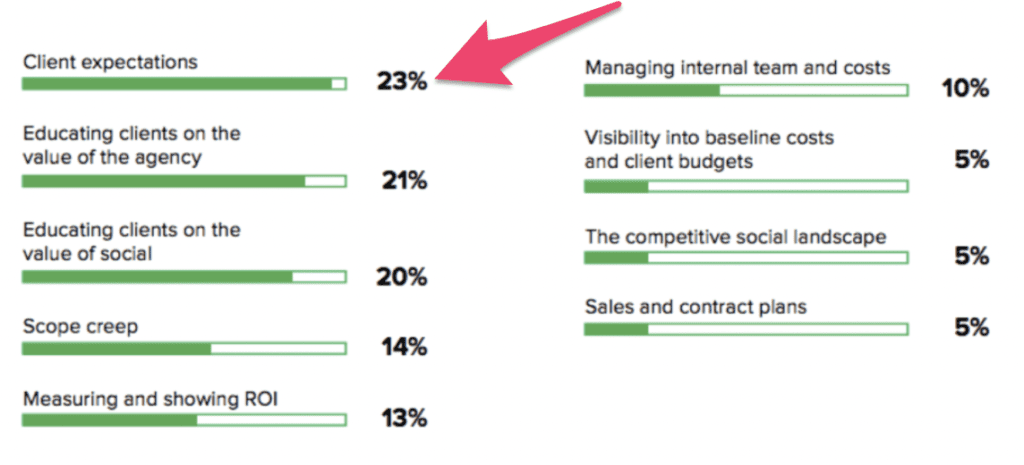 Managing client expectations ranked first in this survey. I’m assuming that you can relate to this problem.
Some clients think that agencies are miracle workers. They sign an agency, and all of their troubles will disappear. Conversions will triple, revenue will quadruple, and customers will be lining up around the block for years to come.
While some of these business owners don’t have a good sense of reality, others get this fairytale image during an agency pitch.
Agencies are over-promising and under-delivering. It’s much easier to follow through with promises if you set realistic expectations from the beginning. I’d rather under-promise and overdeliver. That makes you look better than the opposite. Here’s an example:
Managing client expectations ranked first in this survey. I’m assuming that you can relate to this problem.
Some clients think that agencies are miracle workers. They sign an agency, and all of their troubles will disappear. Conversions will triple, revenue will quadruple, and customers will be lining up around the block for years to come.
While some of these business owners don’t have a good sense of reality, others get this fairytale image during an agency pitch.
Agencies are over-promising and under-delivering. It’s much easier to follow through with promises if you set realistic expectations from the beginning. I’d rather under-promise and overdeliver. That makes you look better than the opposite. Here’s an example:
| Promise | Realistic Expectation |
|---|---|
| Number one organic position on Google within three months | Average customer increases organic traffic by 20% within six months |
| Double your traffic in a week | Achieve 50% increase in six months |
Leverage the Right Tools and Technology
To keep up with the growing demands of your client base, agencies must adapt and use tools to their advantage. Technology can be used for such a wide range of purposes. Look into software for automating manual tasks. Consider updating any old technology before it becomes obsolete. These are the top factors that agencies use the most when evaluating new business tools.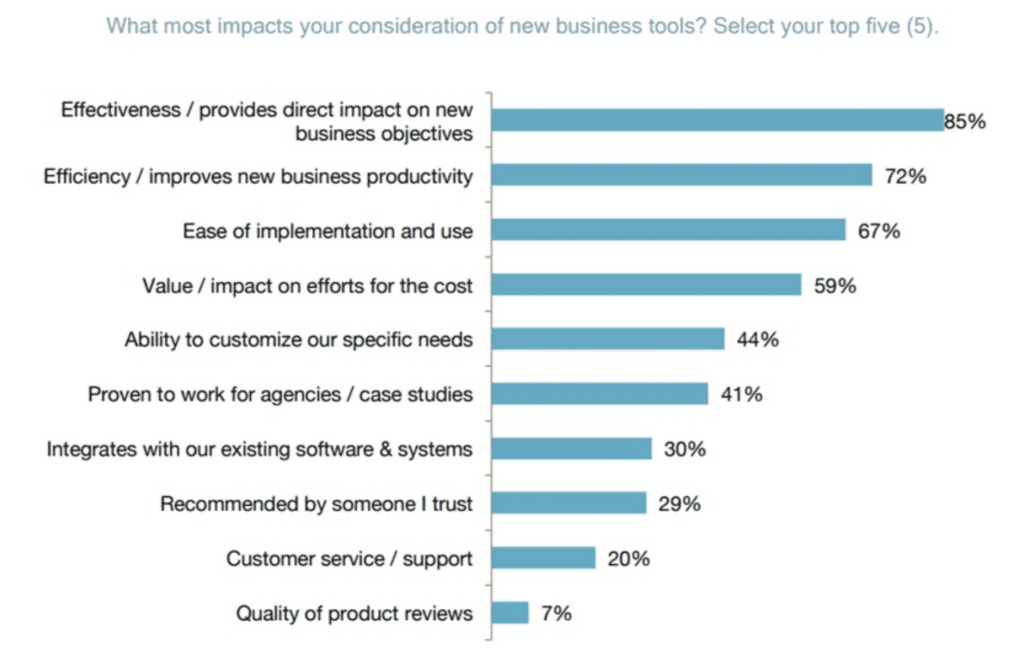 I tend to focus on tools that improve efficiency. New technology can be used for in-house purposes, as well as for client offerings.
Like most of the elements in this guide, an app reseller program fits the bill in nearly every response on this list.
I tend to focus on tools that improve efficiency. New technology can be used for in-house purposes, as well as for client offerings.
Like most of the elements in this guide, an app reseller program fits the bill in nearly every response on this list.
- Direct impact on business objectives
- Improves new business productivity
- Value on effort for the cost
- Ability to customize
- Proven to work for other agencies
Focus on Problem Solving
Why should a business hire your agency? This is not a rhetorical question. It’s easy to get lost in your agency offerings and lose sight of problem-solving. I speak to dozens of agency owners throughout the year. When we’re talking about business, most of them usually just list their services. “We do social media marketing, content creation, email marketing, SEO, web development, etc.” But none of those are reasons why a business should hire you. This is: “We improve mobile conversions and reduce operational costs for small business owners.” This is obviously just one example. But you can clearly see the difference between this statement and the previous one that just lists services. Your services alone do not solve problems. The solution is to recreate your value proposition.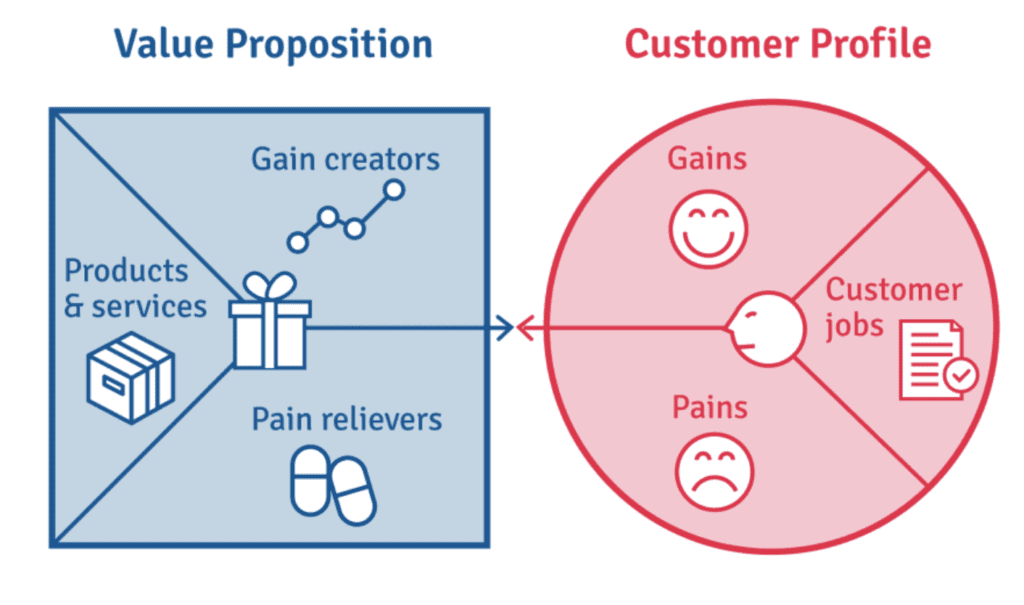 A value proposition is not a company slogan or mission statement. It’s also not a list of your services.
By definition, a value prop is a way to attract clients to your agency. But the only way to do this correctly is by focusing on problem-solving. The two terms work together hand-in-hand.
A value proposition is not a company slogan or mission statement. It’s also not a list of your services.
By definition, a value prop is a way to attract clients to your agency. But the only way to do this correctly is by focusing on problem-solving. The two terms work together hand-in-hand.
Conclusion
Excellent customer service doesn’t happen overnight. An agency must make customer success part of their company culture. The concept of customer success goes beyond signing a new prospect. It needs to continue throughout the entire lifetime of your relationship with the client. Your agency has to stay up to date with the latest technology, tools, and trends. In doing so, you’ll be able to meet the demands of B2B clients in the modern era. Everything is heading toward mobile. Agencies that can accommodate their clients’ needs will have great success in the coming years. That’s why becoming a mobile app reseller is such an effective agency strategy. It’s easy to implement, cost-effective, and results-driven. For more app reseller tips, tools, and best practices related to agencies, subscribe to the Buildfire blog. You’ll be among the first to know when we publish new and relevant content for agencies.Frequently Asked Questions
How can agencies improve their customer success strategies?
Agencies can enhance their customer success strategies by adopting a holistic approach that includes listening to client needs, staying updated with industry trends, and customizing services.
What role does listening play in customer success for agencies?
Listening is crucial as it helps agencies understand client needs, leading to better service customization and higher conversion rates.
Why is it important for agencies to follow industry trends?
Keeping up with industry trends allows agencies to provide cutting-edge services and maintain a competitive edge.
How can app resellers benefit from using Buildfire?
App resellers can leverage Buildfire’s platform to create customized apps that meet diverse client needs, enhancing customer satisfaction and retention.
What are the key components of a successful app reseller program?
A successful app reseller program includes understanding client needs, offering tailored solutions, and staying updated with technology trends to provide the best services.