
Now that you have finally decided it’s time to build a mobile app, there are some decisions that need to be made.
One of those decisions is choosing which operating system you’re going to launch on.
You have to decide between the Apple App Store or the Google Play Store.
It’s not an easy choice.
Key Takeaways
- Platform Choice: Choosing the right platform is crucial as iOS and Android users have different behaviors.
- Development Requirements: Native apps require separate development for iOS and Android due to different coding requirements.
- Cost Implications: Developing for both platforms can be costly and time-consuming.
- Monetization Strategies: The platform choice can impact your app’s monetization strategy, with iOS favoring paid apps and Android favoring ads and in-app purchases.
- User Engagement: iOS users may be more engaged if they pay for the app, while Android users offer a larger market share.
Why?
Well, for starters, Android and iOS app users behave differently.
So if you launch on the wrong platform, you could be neglecting your primary target audience.
If only there were a solution that didn’t force you to choose.
Spoiler alert – there is.
But we’ll get to that later.
For now, we’ll operate under the assumption that you’re building a native app.
In this case, you’ll have to pick between Apple and Android. But iOS and Android app development are very different.
Here’s why.
The code for native apps doesn’t work on both platforms.
If you want to have an app that’s available in both stores, you’ll need to develop two different ones from scratch in order to meet the requirements for each operations system.
It’s a long and expensive process.
Trust me, I know from experience.
But with experience also comes knowledge.
I’m here to share expertise with you so that you can make an informed decision before you dive head first into the wrong operating system.
I’ll even show you a way that allows you to launch on both platforms simultaneously.
Here’s what you need to know.
First, I’ll break down all of the factors that you need to consider before you finalize a decision between iOS and Android apps.
Feature sets
The features are related to the basic functions of your app.
What exactly is the purpose of your app?
The answer to this question will depend on the code that gets written for development.
Apple – iOS App Development
Apple is restricted to a closed ecosystem.
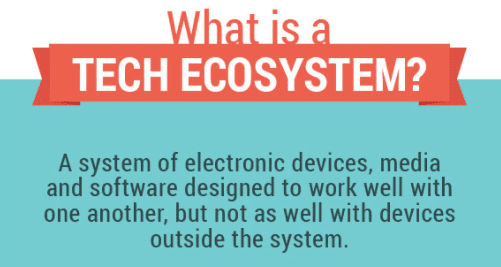
A closed ecosystem means that Apple regulates entrance to use their platform.
All of the content is restricted to specific iOS devices that are supported by that ecosystem.
This means that iOS developers must use Apple’s features, and there are a lot of them.
The advantage to developing your app on a closed ecosystem like Apple’s means that there’s more control and stability.
But with that said, there will be more restrictions for the developer.
From the user perspective, purchasing a device that operates on a closed ecosystem means that it will have a higher price point.
So in general, Apple devices are more expensive than Android devices.
This gives you some more insight about the user, but we’ll get into that in greater detail shortly.
Android App Development
Android operates on an open source ecosystem. This makes it easier for Android developers to build an Android app.
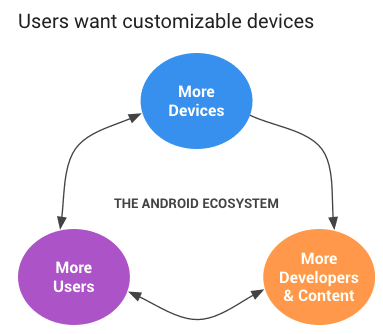
This allows for tons of modifications as well as lots of functionality.
Open source platforms are less secure.
So sometimes updates get blocked by mobile network operators.
Android has an open platform to encourage developer innovation.
You can get Android’s source code for free and port it to your app’s hardware.
This means you won’t have to jump through as many hoops to develop your app on the Android system because there are less restrictions.
How to make money
The purpose of every mobile application is to make money, right?
If that’s not your primary goal, you’ll probably need to reevaluate your decision to build an app in the first place.
So how do you plan to make money?
Here are a few of the most common business models.
- Subscriptions
- In-app purchases
- Advertisements
- Pay per download
Depending on which strategy (or strategies) you decide to implement can impact your decision for developing on Apple or Android.
Apple
If you’re going to charge users to download your app, you should develop on Apple first.
Take a look at the distribution of free vs. paid apps between Apple and Android.
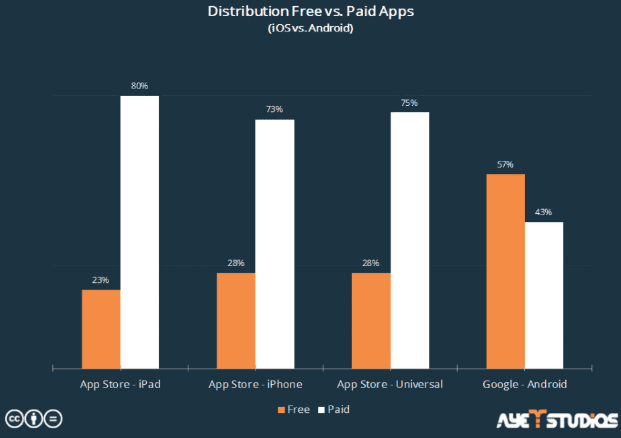
As you can see from the graph, there is a clear difference between the two platforms.
So if you’re going to charge for downloads, the Apple App Store is the place to do it.
That’s because those users are used to seeing more paid apps and less free apps when they’re searching for something to download.
Whereas Android users don’t see as many apps that require payment to download.
So if they see yours, they’ll probably consider just finding another one that has similar functions and is offered for free.
Just know that if you’re going to charge Apple users to download your app, it’s going to be an expensive strategy.
You’ll have a much higher customer acquisition cost than if you offered it for free.
But with that in mind, you’ll also make more money all at once.
Your users will be more engaged as well.
If they’re willing to pay for it, that means they probably won’t abandon it.
Android
If you’re going to make money off of advertisements and in-app purchases, then you should build on Android first.
Just don’t expect your to be too significant.
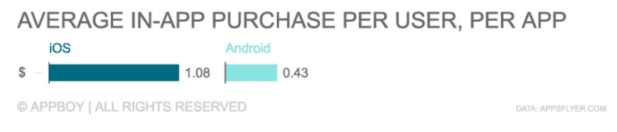
You’re going to get less money per purchase, but that’s spread over way more people.
Android users dominate the market share.
I’ll show you some more specific numbers when we talk about the different types of people using your app in a little bit.
The advantage of releasing your app for free on the Android platform is that you’ll be able to get more downloads.
But your users may not be as engaged since they’re not investing anything into the download.
So the key to this strategy is coming up with a way to get money from people who use the app the most.
Charge for app upgrades and premium services to enhance their experience.
Release cycles
Software Version Compatibility
| Aspect | Apple | Android |
|---|---|---|
| Software Update Adoption | 95% of users have one of the two latest operating systems installed. | Less than 20% of users are on the two most recent versions (Oreo and Nougat). |
| Development Complexity | Easier, as most users are on the latest versions. | More complicated, due to a wide range of versions in use. |
Tablet usages
When people think about building mobile applications, they immediately think of cell phones. But you’ve got to take tablets into consideration as well. Look at how tablet ownership has been trending.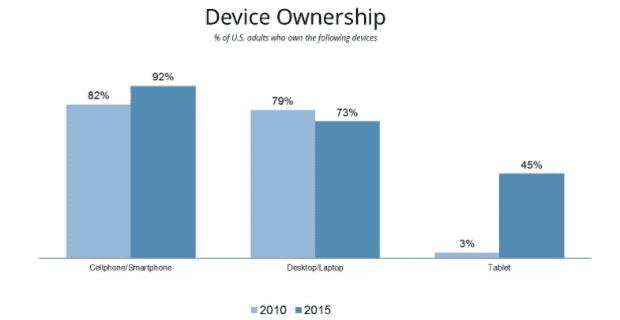 Over a stretch of five years in the United States, we saw a 42% increase in tablets owned.
That number is continuing to rise.
So you need to keep tablets in mind when you’re developing your app.
Over a stretch of five years in the United States, we saw a 42% increase in tablets owned.
That number is continuing to rise.
So you need to keep tablets in mind when you’re developing your app.
Apple
Most people like to use iPads because they are user friendly. These tablets are sleek and easy to use. They are a popular choice for young children as well as older generations. The users who use Apple tablets will watch movies, play games, or spend time doing other fun activities.Android
On the other hand, people who own Android tablets are more technical. They may be using these devices to work on a project or own one because they use it for their job. Overall, Apple tablets seem to dominate Android. You may even see some people who have an Android phone but use an iPad tablet. But iPhone users are much more loyal to Apple’s tablets and other devices.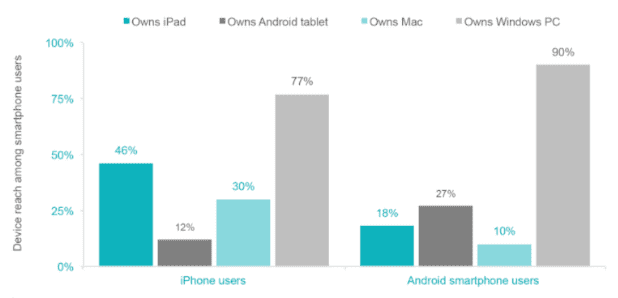 You’re way less likely to see an iPhone user with an Android tablet than an Android smartphone user with an iPad.
Enterprise adoption
Remember when Blackberry used to dominate the workplace market? It seemed like everyone wearing a suit and holding a briefcase had a Blackberry in their hand as well. But those days are over.Apple
Apple devices are known to be more secure. We discussed this earlier when we talked about their closed ecosystem. That’s why you’ll see major corporations like IBM partnering with Apple for their corporate devices. But with increased security comes fewer features.Android
Since Android is open source, it’s less secure. But with that said, there are way more devices and even more features. Apple users have to get an iPhone or iPad to access your mobile app. While there may be different versions of those devices, you can’t compare that to the number of devices that operate on the Android platform. That’s probably another reason why Android dominates the global market share.Why there are two platforms
To avoid any confusion, let’s start with the basics. Apple devices run on iOS software and Google devices run on Android’s operating system. On a global scale, Android dominates the market share.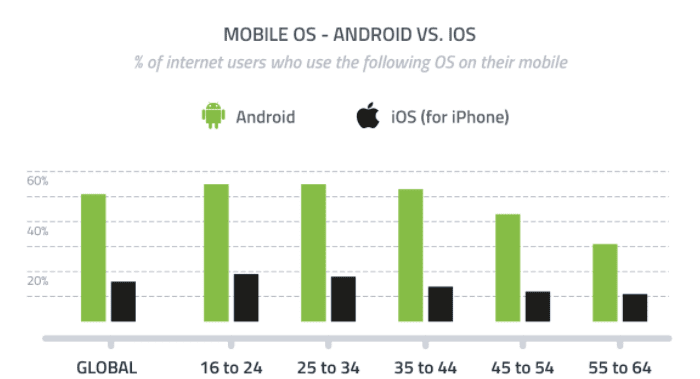 But in the United States, it’s closer to an even split.
Apple users access the mobile store through their iPhones and iPads.
While Android users have more options with phones like the Google Pixel, HTC, Samsung Galaxy, as well as more phones and various tablets.
The variety of devices may explain why Android has more users across the world.
But that doesn’t mean it’s the best choice for your development and launch strategy.
It all comes down to the primary function of your app and your company’s target market.
Mobile apps are a business.
This statement holds true whether you’re building a new app from scratch or launching one to improve your existing company.
But running a business, or in this case, a mobile app, means you’ve got to have a marketing strategy.
It’s much easier for those of you who already have a business with an existing customer base.
Look to those customers to tell you which operating system they prefer.
If you’ve never built an app before I know what you may be thinking.
Why can’t I just develop both?
Well, in theory, you can. But it’s going to cost you a lot of money.
If you’ve got a minimum of a few hundred thousand dollars to spare and up to a year of time to invest, you can probably build two native apps at the same time.
But for everyone else out there you’ll have to choose between Apple, Android, or the third (and probably most reasonable) option.
But in the United States, it’s closer to an even split.
Apple users access the mobile store through their iPhones and iPads.
While Android users have more options with phones like the Google Pixel, HTC, Samsung Galaxy, as well as more phones and various tablets.
The variety of devices may explain why Android has more users across the world.
But that doesn’t mean it’s the best choice for your development and launch strategy.
It all comes down to the primary function of your app and your company’s target market.
Mobile apps are a business.
This statement holds true whether you’re building a new app from scratch or launching one to improve your existing company.
But running a business, or in this case, a mobile app, means you’ve got to have a marketing strategy.
It’s much easier for those of you who already have a business with an existing customer base.
Look to those customers to tell you which operating system they prefer.
If you’ve never built an app before I know what you may be thinking.
Why can’t I just develop both?
Well, in theory, you can. But it’s going to cost you a lot of money.
If you’ve got a minimum of a few hundred thousand dollars to spare and up to a year of time to invest, you can probably build two native apps at the same time.
But for everyone else out there you’ll have to choose between Apple, Android, or the third (and probably most reasonable) option.
When to develop for Apple first
You’ve got to find some common connections between your customers and the behavior of Apple users. So do some research. For example, men spend more money on Apple products than women.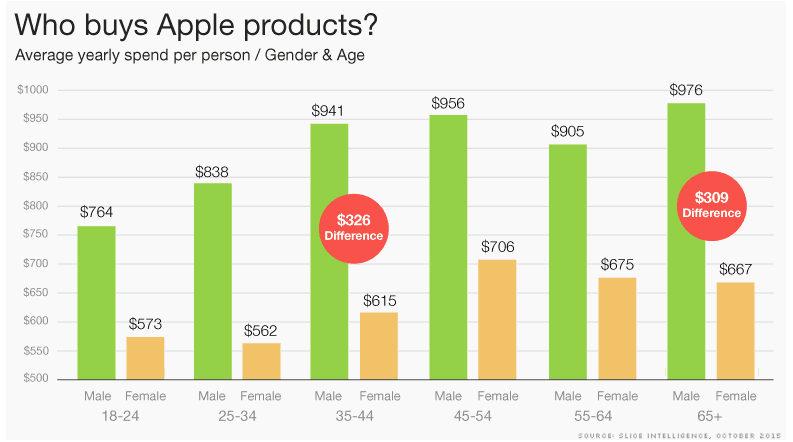 The graph shows that there is a significant difference between the two genders in this category.
Does that mean you should develop your app for Apple first if your company’s primary target market is men?
Not necessarily.
I included this graphic for a reason because it’s a perfect example of misleading information.
While the researc
The graph shows that there is a significant difference between the two genders in this category.
Does that mean you should develop your app for Apple first if your company’s primary target market is men?
Not necessarily.
I included this graphic for a reason because it’s a perfect example of misleading information.
While the researc| Aspect | iOS | Android |
|---|---|---|
| Annual Income | Apple device users earn 40% more each year | Lower average income compared to iOS users |
| Push Notification Engagement | 1.77% open rate | 3.48% open rate |
| Cost Per Install (CPI) | Higher CPI | Nearly half the cost of iOS apps |
| Development Cost | Expensive | 30% more expensive than iOS |
| App Approval Process | Strict and detailed | Automated and lenient |
Final Thoughts on Android and iOS Development
So, which is the best operating system to build on first? It depends.| Scenario | Favored Platform |
|---|---|
| Targeting an American audience with higher education and a substantial annual income | Apple |
| Target market is global and planning to drive sales through ads instead of in-app purchases | Android |
Frequently Asked Questions
Should I develop my app on iOS or Android first?
Choosing between iOS and Android depends on your target audience and monetization strategy.
What are the cost implications of developing for both iOS and Android?
Developing for both platforms can be costly and time-consuming as it requires separate coding.
How does the closed ecosystem of Apple affect app development?
Apple’s closed ecosystem provides more control and stability but imposes more restrictions on developers. This can impact the flexibility of app features.
How does Android’s open-source nature benefit developers?
Android’s open-source platform encourages innovation and allows for extensive modifications, making it easier for developers to customize their apps.