
“Content is king” is a mantra that marketers have invoked for the past few years—and for good reason. Content marketing is a new breed of marketing designed to work around the inherent flaws in conventional advertising; it’s the driving force behind digital marketing channels such as SEO and social media. It’s not a stretch to say content marketing is the key to a successful digital marketing strategy.
If you’re new to content marketing, or not sure where to start, take heart. You need to have fresh ideas. This primer will walk you through content marketing in 2021 and give you concrete steps to implement a new content strategy or improve the one you already have—no matter your budget or the size of your marketing team. Ready to begin?
What Is Content Marketing?
The Content Marketing Institute gives this rather formal definition:
“Content marketing is the marketing and business process for creating and distributing relevant and valuable content to attract, acquire, and engage a clearly defined and understood target audience – with the objective of driving profitable customer action.”
More simply, content marketing provides prospects and customers with interesting and useful information that answers questions, addresses needs, or engages emotions to help your business meet its marketing goals. Content marketing is a non-pushy, authentic way to establish relationships and share your brand’s story.
The concept has been with us for decades, actually. In the old days, a brand like Nestle might print a recipe or two on the back of a package of chocolate chips or put an ad in a magazine featuring fool-proof fudge. Today, they’ll publish an interview with a chocolatier on their blog, use a Pinterest board to share recipes and tips, put cooking demonstrations and how-to videos on their YouTube channel, and run a holiday cookie photo contest on Instagram. The concept is the same, it’s the tactics that evolve.
Here are some eye-popping content marketing stats:
- 92% of businesses engage in content marketing.
- 70% of marketers plan to increase their content creation this year.
- The average company spends 28% of its overall marketing budget on content marketing; the most effective marketers spend 37% on content.
- 55% of businesses plan to increase their content marketing budget this year.
No matter what business you’re in, you need content marketing in order to compete.
Defining Your Objectives
What do you want your content to accomplish for your business? Defining your objectives helps you align your content strategy to help you achieve them. Here are just a few examples:
- Establish thought leadership to build credibility, respect, and influence in your industry
- Generate new leads and prospects for sales and marketing
- Create awareness of, and interest in, your products or services
- Build and/or improve public opinion about your business and products
- Develop a large following of friends and fans who engage with your brand on social media
From here, you’ll decide on how content marketing will fit into your overall marketing scheme. A sample strategy for building paid memberships might be:
Newsletter → Blog Post→ Social Media⇒ Paid Membership Site
A strategy to drive B2B product sales might look more like this:
Journal Article→ White Paper→ Case Studies→ Product Demo⇒ Sales/Estimate/Quote
An effective strategy usually combines several content tactics:
- blog posts
- video demos
- podcasts
- articles
- newsletters
- white papers
- case studies
- infographics
- ebooks
- webinars
- interviews
As you craft your strategy, keep in mind the difficulty factor in creating each type of content, how it fits with your overall objectives, and if your target audience is receptive to information in that format.
Set SMART Content Marketing Goals
Every piece of content you publish should be aligned to a particular marketing goal, and those goals should be SMART:
S – Specific (It’s attached to a particular need or objective.)
M – Measurable (You have objective, not subjective, metrics.)
A – Attainable (You can realistically expect to achieve it or at least come pretty close.)
R – Relevant (It furthers an overall business objective.)
T – Time-bound (You have a predetermined deadline or end-date.)
Avoid vanity metrics such as “likes” and retweets; in themselves, they aren’t aligned with your marketing goals. Think in concrete terms like traffic, leads, conversions, sales—objectives shared across multiple teams throughout the organization.
Develop a Plan for Content Creation and Execution
Once you know the type of content you want to publish, you need to develop a plan to create it. It’s not enough to jot down a rough outline and some notes; the most effective content marketers report having a documented content plan that is shared across the organization and for which they are accountable. Take the time to complete a step-by-step roadmap that enables you to monitor your efforts and track each piece of content throughout its lifecycle.
Your plan should answer the following questions:
➤How often will you publish content? For some businesses, this may mean daily blog posts, twice daily social media updates, a weekly podcast, and a monthly video tutorial. Others might need a steady stream of lead magnets (e-books, white papers, etc.) and a couple of fairly evergreen product demos.
When you’ve hammered out your content needs, plug them into a content calendar you can share with your marketing team. That way, everyone is on the same page, deadlines don’t get missed, and you avoid duplication of effort.
➤Who is responsible for content ideas? If you’re pushing out a steady stream of content, you’ll need an equally steady stream of content ideas. In most cases, the marketing department does all the brainstorming, but this excludes some excellent sources of content ideas.
Your customer service manager, for example, could give you some useful ideas for a Q&A to address the most common questions the department handles, or a how-to video to solve a persistent challenge. Maybe your tech guru could write a monthly rant or product review. The point is not to limit ideation to a small team of marketers, but to cultivate ideas throughout the organization. Just be sure that someone has final editorial control so that your content ideas align with your marketing goals.
One thing to consider: In many cases, it’s helpful to write a creative brief for each piece of content, especially if you’re using multiple creatives or freelancers along the way. The brief should include an outline of the project and its intended purpose, the target audience, the name and role of each person involved (writer, photographer, editor, etc.), and deadlines for each part of the process.
➤Who is responsible for actually creating the content? Once you have your content ideas and content calendar, you need to assign responsibility for actually creating the content. Each person involved in a particular piece should know where he fits into the overall project and who is ultimately responsible for delivering the finished product.
➤What has ultimate editorial authority? For many, if not most, of your pieces of content, final approval rests with the marketing department itself—blog posts, social media updates, newsletters, and landing pages are usually the province of the marketing staff.
However, once you move into high-value assets such as white papers, case studies, and product demos, input and approval from other departments is essential. For these complex assets, write up a chain of command and get sign-off from relevant department heads. Have a process in place to resolve the inevitable differences of opinion and establish a single person as the final authority for the finished piece.
Identifying Your Audience
One of the reasons content marketing is effective is because it speaks to readers as individuals—if you’re writing content to address a group of people, you’re doing it wrong. To write really effective content, you need to identify exactly who it is you’re writing to, at a very granular, nitty-gritty level. At this point, it’s helpful to develop an avatar, or persona, who represents your target audience; this is the person you’ll write your content for. Start with demographics:
- age
- gender
- educational level
- income
- occupation
- family status and/or size
- geographic location
Then add in intangibles:
- values
- personality traits
- lifestyle choices
- hobbies and interests
Once you’ve identified an ideal representative of your target audience, your avatar, give it a name and address all your content to him or her. Your avatar is not the same as your buyer persona; your avatar will help you write more focused, engaging content that advances your marketing goals.
Next, you’ll need to find out where your target audience lives online. Here’s a handy infographic with key demographics for the popular social media sites; you can also use paid services like Forrester to help you track the social behaviors of your own customers so you know exactly where they go for content online. This will shape your content creation choices.
Matching Content to Your Marketing Funnel

Image via Flickr
Most marketers have some version of the digital marketing funnel that covers the four basics: Awareness/discovery, consideration/acquisition, conversion/transaction, relationship/retention. The beauty of content marketing is that it works at every level, from top to bottom.
Awareness/Discovery
Goals: Educating people, generating interest, indirect customer acquisition.
At this stage, content marketing is about understanding what customers are interested in and want to know, and delivering that information in a manner that delights them or piques their curiosity. It’s less about you (and your brand) and more about them. Educational content, viral content, shareable content—big wins at this stage of content marketing.
Content tactics:
- blog posts
- quizzes, games, tools, calculators
- infographics
- videos
- newsletters
- how-tos and in-depth guides
- podcasts and webinars
- ebooks
Real-world example:
A pet supply shop specializing in premium organic pet foods and supplements publishes a quiz about common ingredients in commercial pet food on its blog and promotes it on its Facebook page, posts photos and a recipe for homemade dog treats on Pinterest, and records an interview with a local vet about optimal nutrition for older dogs for its monthly podcast.
Consideration/Acquisition
Goals: Building trust, offering solutions, direct customer acquisition.
At this point, you are highlighting problems your prospects and customers might have and offer your products and services as trustworthy solutions. At this stage, you want to offer information that helps differentiate you from your competitors and answers questions about how you can solve their problems. You’re not really selling at this point, but you are positioning your brand.
Content tactics:
- case studies
- product descriptions and data sheets
- how-to guides featuring your product or service
- product demos and videos
- white papers
- ROI calculators
Real-world example:
A residential heating and air conditioning company creates an in-depth guide showing homeowners how to save money on energy costs. One section details the importance of having air ducts professionally sealed, a service the company offers. They offer the guide on their company website and promote it in their newsletter, blog, and on social media.
Conversion/Transaction
Goals: Communicating your unique value proposition, getting prospects/customers to take a desired action.
Leads at this point in the funnel are ready to pull the trigger, they just need a little nudge—something that justifies and rationalizes the decision in their mind. Now is the time to pull out the stops in your sales pitch with clear copy that emphasizes your USP.
Content tactics:
- testimonials
- product reviews
- product comparisons
- estimates/quotes
- ROI calculators
- detailed product descriptions
Real-world example:
A software company creates a matrix comparing the features of competing products in its particular market niche. It also produces a series of video testimonials from companies of varying sizes currently using their product. Finally, it designs a pricing calculator that gives clear, straightforward information about initial and ongoing monthly costs.
Relationship/Retention
Goals: Building customer loyalty, creating brand ambassadors, increasing customer lifetime value.
All marketers know it’s cheaper to keep existing customers than to find new ones, and this stage of the funnel is all about relationship-building and retention. It’s about creating loyal customers who tell others about your brand.
Content tactics:
- onboarding emails
- troubleshooting tips
- customer help and support materials
- loyalty programs
- special offers
- insider tips and how-tos
Real-world example:
An online cosmetics retailer invites customers to join their loyalty program in their purchase confirmation emails. It sends customers an email when their orders ship and sends delivery confirmation notifications via SMS text or mobile app. They use marketing automation to email customers a special birthday discount or free gift, and to alert customers when a favorite product goes on sale.
Creating the Right Content
There are three main elements in formulating a good content marketing strategy:
- Ideation—coming up with right ideas for compelling content.
- Format—matching your ideas to the appropriate channels.
- Creative—identifying actual content creators.
These three pieces are the same whether you’re a small business owner handling marketing on your own or a large company with a 10-person marketing team—it’s just a matter of scale.
Ideation
The first step is coming up with topics that your target customer is interested in and wants to read about. In some cases, identifying good topics is as simple as brainstorming with a co-worker or a friend or reading questions and comments from your customers to see what’s on their mind; some niches are much easier than others. For other businesses, however, a little market research is in order.
- What topics are your competitors writing about?
- What content is getting buzz on social media? There are free tools like Sumo to help you identify popular content.
- What’s trending in your industry right now?
Keep this checklist in mind as you consider topics for content creation:
Format
The best content ideas can be repurposed and cross-promoted across multiple marketing channels, but it’s still important to match your content ideas to the unique characteristics of each platform. Want to write about gluten-free baking alternatives to wheat flour? A long-form article is great for a newsletter or blog post, a recipe for gluten-free hazelnut torte is a natural for Pinterest, and an infographic is an eye-catching option to tempt your Facebook and Twitter followers.
Don’t forget that some consumers prefer visual content; Google+ hangouts, Slideshare presentations, screencasting are all interesting alternatives to written pieces.
Creative
Identifying who will be responsible for actually creating your content can be one of the most challenging decisions you’ll make as a content marketer. In many cases, you have the talent in-house to create interesting content—think of an interview with your resident tech geek or an in-depth look at pending legislation by your internal subject matter expert, for example.
Most marketers will have to outsource at least some of their creative work at some point or other, however. Outsourcing offers you an opportunity to tap deeper expertise and, in the case of many guest authors, a broad social following that amplifies the impact of your posts. In the next section, we’ll look at budgeting and asset allocation for content development and when outsourcing makes sense.
5 Smart Ways to Find Content Marketing Ideas
As much as you want to put out stellar content on a regular basis, it can be tiring. Sometimes, you just run out of ideas to write about and create anything with.
Especially when you’re a small team or alone, the idea will can dry up pretty quick. But most of the time, it’s just a matter of having something trigger your brain into creativity again. Taking and sharing ideas aren’t all bad. They aren’t bad at all.
1. Use questions to spur new ideas
I think the biggest reason we run out of ideas is because we always go about the same process of creating and finding them. A great way to shake things up a bit is to ask questions to yourself. If you’re part of a team, collectively answer these questions.
This collection of questions help you to see things in a different perspective, think of your industry in ways you’ve never before, find information gaps in your content strategy and overall kick your content ideation to high gear.
� What do prospect always ask about?
� What’s a question you always prepare for but never gets asked?
� What are some unfounded beliefs in your industry?
� What are the last points of doubt of someone who’s already willing to buy?
� What isn’t being asked around here?
� What’s something we’ve always believed that isn’t really true?
� What are the common complaints in your industry?
� What’s something that can be improved in your niche, culture-wise?
2. Social media: Facebook Groups
Facebook groups are wildly popular across all industries.
Doesn’t matter if you’re from “serious” niches like executive coaching or physical therapy, there is a Facebook group that caters to your area of business.
In these groups, engagement is quite high—people are commenting, asking questions, sharing experiences and overall just being a good online community.
Now how do use Facebook groups to get new content ideas? On Facebook, type your industry or field in the search bar and click Groups.
For example, you’re running a woodworking shop or supply store. Let’s search for woodworking.

Join the top groups. Look at the number of people in them. I think if it’s less than 500 people, there’s not much to get from the group. That’s not a hard rule though. If it’s a Public group, you can snoop around before deciding to join. If the engagement is low, better skip the group for now. Remember, we are talking about idea generation and not community building for this post.
If there are Public groups, you can immediately get in and start scanning conversations, shared posts and links. From there, you can get an idea of mundane and common concerns on the ground level.
Let’s see what woodworkers like to talk about.


After a quick scan, it’s apparent that woodworkers love showing off their work.
Why not create a post for your audience teach them how to showcase their work online? Or photography suggestions for woodworking pieces?
Of course, joining the conversation is the strategic approach. Post questions, share your ideas—it will pay off when you gain the trust of this highly targeted group.
3. Online tool: Google News
Who knew? Google News isn’t just a bland Google feature. If you’ve had the chance to use it, you’ll know what I mean.
Google News is a nifty Google product that shows you the latest news. Now, when we think of news, it’s either politics, economics, or any of the more traditional topics that scream news.
Google News is a bit forward thinking. First, it covers ALL searchable topics and will show you the latest news piece and even blog posts. Second, not all posts make it to Google news. They only show high-quality and reputable websites.
You probably know where I’m going with this: Use Google News to find out what the best of the best are talking about. From there, you’ll surely get a topic you can build on using your own perspective.
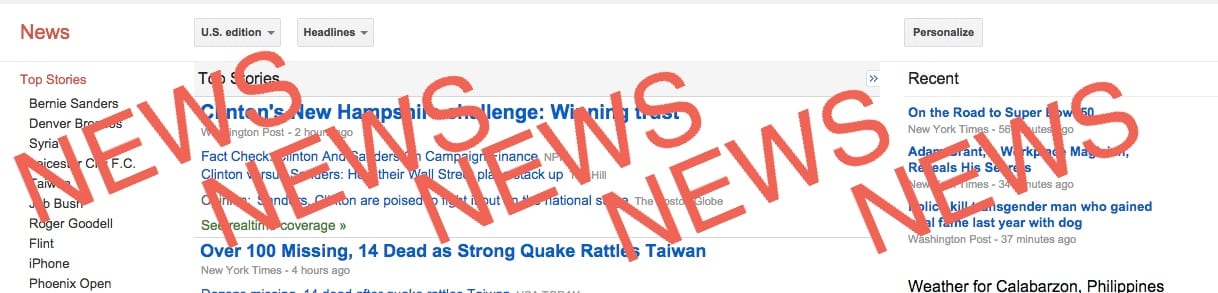
Of course, if your niche is politics or sports, you might get good ideas from the frontpage of Google News. If you’re from a very targeted niche though, you need to utilize Google News’ robust search algorithm.
Say you are a home care facility and you’ve run out of ideas to write about in your blog. Go to news.google.com and just type a random word that’s related to your niche. In this case, let’s use homecare.

The search will return news from your niche—latest technology, new practices, good blog posts. It’s never a bad idea to keep yourself sped up to the top tier. Synthesize the ideas and come up with something from your perspective!
4. Social Listening Tool: BuzzSumo
I love BuzzSumo.
Ok, so now that we have the bias out of the way, let me show you how awesome BuzzSumo is for coming up with content ideas.
Here’s what Noah Kagan of AppSumo said about BuzzSumo:
Buzzsumo is also a great place to see which topics related to your business get the most attention. Do more of what works.
BuzzSumo is a social listening-content marketing swiss knife. You can find out the best people to reach out to in terms of expertise and audience size, you get data as to what’s trending at the moment, and for the purposes of this post, BuzzSumo shows you which pieces of content works in your industry and around the topics you create content for.
They don’t stop at topics, they include information on the content type (articles, inforgraphics, video, etc.) that works best in your niche. They have various filters like location, language and dates so you can adjust according to what you’re looking for.
For example, we’re searching for popular posts around the coffee niche. I typed in coffee in the BuzzSumo search bar and the results page looked like this:
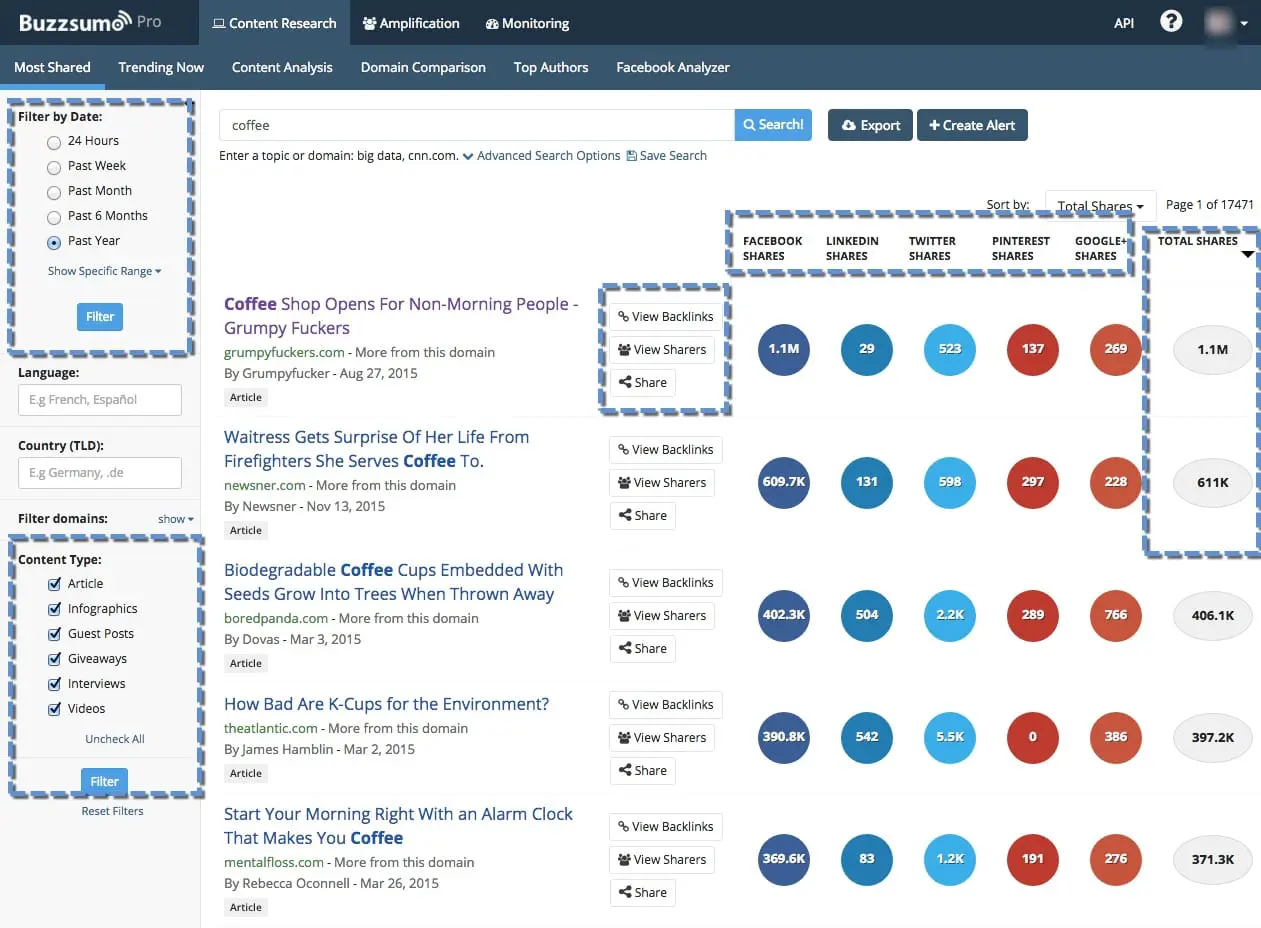
Right smack in the results, you’ll get the most shared content in the last year (default filter). Just by looking at what’s popular, you can get an idea what you can create for your own business. Looks like for coffee, the newer and more sustainable practices are widely-shared. Of course, the top post is viral-worthy and quirky.
Take what you can from these top posts and transform it into your own content that fits your context.
5. Read industry blogs: Leaders, competitors, new players
With the boom of content marketing, it’s tough to differentiate yourself from your peers. Now, that has to have you wondering.
If I have to differentiate myself from my peers, why would I turn to competition to get content ideas?
Well, frankly, a lot of the content out there flat-out sucks. If there’s one business who would make improving content its advocacy, that business would make a killing.
So, here’s what you can do.
Subscribe to newsletters
Carefully choose who you subscribe to. Emails today are full of noise so make sure to vet blogs before signing up. You don’t want to waste precious minutes going over emails that just don’t add anything to your life. Blogs that send one email digest a week are generally better in my experience. They take time to curate the content they share to your personal space (inbox) and these people are carrying out elaborate email marketing funnels so you’re sure that they’re providing your value because they want you to buy-in.
Create Twitter lists
Remember, not everyone with more than 10,000 subscribers is an influencer. With so many tools out there meant to grow your Twitter following, a lot of the profile followers are just vanity, meaning they don’t bring value at all. So, what you can do is take the handful of people you already follow and whose content you trust and go over their profiles to see who they follow. Follow those people. Group them into lists based on niche/industry/specialization. When you’re running out of ideas, check the feed of the list. You’re sure to get a topic or two that can feed your imagination.

Set aside an hour a day for industry-related reading
Even when you’re not in ideation mode, knowing what’s up in your industry is a MUST. Keeping your idea funnel full is the best way to escape running out of ideas ever. Make it a practice to internal brainstorm as part of this reading time. In today’s world, it’s easy for our minds to go numb because of the info bombardment. Don’t let that be you.
Frequently Asked Questions
What are some effective content marketing strategies for small businesses?
Small businesses can leverage blog posts, social media, and email newsletters to engage their audience.
How do I measure the success of my content marketing efforts?
Success can be measured through metrics such as website traffic, lead generation, and conversion rates.
What types of content should I focus on for B2B marketing?
B2B marketing often benefits from white papers, case studies, and webinars. These formats help establish authority and provide in-depth information to potential clients.
How often should I update my content marketing strategy?
It’s advisable to review and update your content marketing strategy at least annually, or whenever there are significant changes in your business goals or market conditions.